How Ukraine attracts international investment in Ukraine amid war with Russia, and what it goes for

Ukraine’s ministry of economy speaks of first international investments in the country, and how the state helps businesses

Ukraine’s recovery is impossible without private investment, its top officials have said more than once.

The primary responsibility for attracting investors in Ukraine rests with its ministry of economy. Or perhaps, more precisely, one man, deputy economy minister Oleksandr Hryban, and one tool, Advantage Ukraine.

Despite the active phase of war in Ukraine, the platform is working on sixty projects worth about USD 9 billion, including in the agricultural sector, woodworking, building materials, and wind energy.

LIGA.net spoke to Mr Hryban about the Ukrainian government’s role in attracting investment and the projects that have the best chance of being implemented. Below is a brief summary of our conversation.

What do investors want in Ukraine?

Despite the “positive emotions and sentiments towards Ukraine,” investors have a pragmatic capitalist approach – a project must meet a certain set of criteria, Mr Hryban says.

The first criterion is financial hygiene, that is having an international financial audit for the last three years, previous experience with international financial institutions and commercial banks, and having passed the “know your customer” procedure.

The next step is economic feasibility, whereby the investor assesses whether the applicant’s claims correspond to reality – for instance, what the situation with electrical grid connection is, whether all cost elements are sufficient, how they affect the final cost of the product, and so on.

The potential lender first wants to understand whether everything is in place to reach the KPIs [key performance indicators] that have been set.

What has the war changed?

Prior to the full-scale invasion, Ukrainian businesses seeking to attract foreign investment usually turned to investment banks for assistance. Those helped prepare an application, the necessary audit, and other similar procedures.

However, after Russia’s invasion of Ukraine, all international financial and credit institutions suspended operations in Ukraine because of force majeure clauses in their capital raising agreements.

Therefore, even those Ukrainian businesses that meet the requirements of financial hygiene and investment feasibility have ended up having very few opportunities to raise funds.

That is why Ukraine’s economy ministry launched the Advantage Ukraine project to promote Ukrainian businesses last year. Started as a purely marketing platform, its role has grown over time.

Advantage Ukraine founders believed that there was a great risk of arousing foreign investors’ interest in Ukraine – helped in particular by the global attention and good attitude to Ukraine – only to find them not satisfied when it came to the practical implementation of projects.

How does Advantage Ukraine work?

The platform receives applications from both those seeking investment and those looking for projects.

A team of experts in investment analysis verifies the applicants and communicates with them to sort out what they need. Then Advantage Ukraine experts decide whether to give the green light to a particular request.

To take an example, right now Ukrainian businesses are sending many requests for war risk insurance. Advantage Ukraine helps draft applications, prepare teasers for potential investors, explain what is missing in their request, etc.

On the other hand, the platform’s members convince foreign investors that it is possible to do business in Ukraine even in times of war. 

Currently, the United States International Development Finance Corporation (DFC) is the most active in helping Ukraine, having committed USD 1 billion in various financial instruments, including war and credit risk insurance, loan guarantees, and direct loans.

Joint projects with DFC, therefore, are used as a guide. Ukraine’s ministry of economy expects them to be implemented as soon as possible to show that the country can attract and implement investments.

What are the first investments in Ukraine?

The projects are being developed through two instruments.

The first is war risk insurance. One of the projects within this instrument is in the woodworking industry in the Zhytomyr region, with a total investment of up to USD 300 million, which is about MDF and HDF [medium and high density fibreboard].

Ukraine’s economy ministry highlights the importance of this project: Since such products used to be imported, in particular from Russia, the project’s success will make it possible to “finally knock Russian producers out of the European market.”

Other projects include a building material production plant to be set up in western Ukraine, and an expansion of an oil extraction plant in central Ukraine.  Those are all Ukrainian companies looking for foreign investment.

There is also a project exclusively by a foreign company that is looking for opportunities to insure against war risks to build a vegetable protein production plant. Another foreign company from Austria plans to build a building material production plant in Ukraine.  

The other investment instrument is USD 600 million in direct lending, which is also carried out with DFC. Ukraine’s economy ministry expects that the lending will help mobilise more than USD 1.3 billion into the economy. The projects include:

  • Woodworking, with a plant for the production of sheet glass
  • The agro-processing sector, namely the expansion of an agricultural farm, “a fairly large poultry farm” (a company with a foreign investor, Mr Hryban clarified)
  • Another plant for the production of building materials
  • Construction of a specialised warehouse for a major retailer
  • A private Ukrainian postal operator that plans to build a distribution centre and buy out logistics centres
  • A project to build housing in western Ukraine, to be allocated to internally displaced people

In total, Advantage Ukraine has more than 60 projects in the pipeline, totalling about USD 9 billion.

The specific projects listed above are at a more advanced stage, but there are others as well, including a request from a large foreign investor in the renewable energy sector that has already invested in Ukraine.

It provides for building a new phase of a wind farm, with USD 1.3 billion in investment, and the company is now looking for funds to insure against war risks.

Unfortunately, the institutions that are currently helping attract investment for insurance do not have enough capacity to cover the required amount, so the economy ministry wants to use donor funding to be put into a separate insurance trust fund.

What are the biggest obstacles to attracting investment in Ukraine?

The first is the war – in fact, the already mentioned war risk insurance.

Potential foreign investors are also “starting to remember our traditional chronic problems” with the rule of law and domestic corruption.

There are now fewer questions about corruption, Mr Hryban says, because there is an anti-corruption system, a business ombudsman, and assistance from the government office UkraineInvest.

While VAT refunds were a big problem, the situation has improved, the deputy economy minister assures.

Therefore, the key issues for foreign investment in Ukraine are the rule of law and the judiciary. While Ukraine’s economy ministry is not directly responsible for this, it sees its task as bringing this issue to the Ukrainian leadership.

What is the UkraineInvest government office?

Alongside Advantage Ukraine, there is a government office called UkraineInvest, but they have different tasks.

What Advantage Ukraine does is select projects and communicate with international lenders and investors who are yet to make up their minds on entering the Ukrainian market until they do.

Once investors and lenders agree and work in Ukraine on a specific project, they are handed over to UkraineInvest for support. In particular, the office ensures communication with local authorities, tax authorities, etc.   

International companies that already operate in Ukraine, like Bayer or Carlsberg, and decide to expand production do not need to turn to Advantage Ukraine; they work directly with UkraineInvest, which provides B2G communication.

Ukraine’s reconstruction: questions and common grounds

The post-war reconstruction of Ukraine has drawn immense attention and a number of proposals have been put forward to outline a way forward. Contributions from CEPRGerman Marshall Fund (GMF), CASECASE Ukraine and Anders Aslund and Andrius Kubilius (A&K), a collection of essays by CESifo, and several others have been released over the past months, each with a specific view or recommendations. 

Given the uncertainty associated with the duration and intensity of the war and how it will eventually conclude, these publications generally outline a series of main strategic principles which are independent of the way in which the war ends. To help ongoing discussions on how the reconstruction should look, we have taken stock of these proposals and highlighted commonalities and differences across them. We are advantaged by the fact that the proposals have much in common. Although the devil is in the details, keeping in mind “the big picture” and agreeing on the main principles before diving into these details is always useful. 

Note: in this op-ed we use the terms “reconstruction” and “recovery” interchangeably implying that reconstruction/recovery is not a return to the previous state but it is “building back better”.

What are common principles for reconstruction?

First and foremost, there is a consensus among proposals that minimizing the damage done by Russia today will help reconstruction in the future. Therefore, faster and more intense provision of weapons to Ukraine and strengthening sanctions on Russia are prerequisites for successful reconstruction. No less important is financial support to keep the Ukrainian economy running. At the same time, there is an understanding that some reforms enabling future recovery can be implemented even during the war, as suggested, for example, by the Memorandum of Understanding on provision of the EU macro financial support or the IMF program. The proposals also generally agree that at least in the early stages of Ukraine’s reconstruction a military insurance or other forms of government support are needed to de-risk private investments. 

This reference to EU support underlines another key point, as all of the proposals agree that Ukraine’s reconstruction should be aligned with EU accession. This implies that Ukraine needs to preserve democracy and implement principles of market economy, the most fundamental of which is the rule of law. Similarly, and although not always mentioned explicitly, Ukraine’s NATO membership is no less important than entering the EU, as NATO membership or equivalent security guarantees are essential for lowering the probability of another Russian attack on Ukraine. 

At the same time, the reconstruction should be owned by Ukraine so that Ukrainian players have an impact on reconstruction and have “skin in the game”. This can be realized by the creation of a specialized technocratic agency responsible for reconstruction and EU integration at the same time. The exact design, governance, structure, and spheres of responsibility of this agency are subject to discussion (e.g., the GMF proposal suggests a platform led by G7). While every proposal recognizes the necessity to involve non-EU players into reconstruction, its coupling with the EU accession naturally suggests that the EU will be heavily involved in a number of issues, such as business and trade regulation, energy sector, taxation and other legislation related to the acquis, as well as (re)construction of some infrastructure, such as border crossing points or railroads. Therefore, the presence of EU experts in the agency is highly desirable. At the same time, the Agency should be responsible for coordination of donors so that their funds are used the most efficiently.

Judicial reform (more broadly, law enforcement reform which includes not only courts but also prosecution and security services) is also noted as the fundamental priority for reconstruction. The necessary steps for implementation are quite clear but there is great resistance within the existing system, and therefore close monitoring of reform progress by donors is needed. Moreover, the Ukrainian government has a capacity constraint: it does not have thousands of honest judges to fill the existing vacancies. A solution could be hiring “outsiders” (lawyers who do not have experience as judges), but they need to be trained to international standards, and Ukraine would require support for this training. 

Along these lines, there is a consensus that Ukraine needs public administration reform. This reform will enable all other changes, such as deregulation (economic liberalization), continuation of healthcare and education reforms, and reforms of other public services. In general, a high-quality bureaucracy is essential for an efficient (yet smaller) state which will be needed for the reconstruction and EU integration. In the previous years there were multiple attempts to reform the public service using, for example, project-based technical assistance and/or a dual-track approach such as introduction of directorates. Because of the great inertia of the system, these attempts had little impact. In an ideal world, Ukraine needs a highly professional and targeted corps of public servants whose integrity is beyond doubt and who are able to develop policies based on data and their professional judgment and take responsibility for implementation of these policies. In practice, however, positions in public offices are hardly attractive for high-quality people. This calls for a rationalization of salaries, along with the law enforcement reform  – so that an official is not afraid that he/she will be put in jail for his/her policy choices. 

The proposals on reconstruction also underline the importance of continuing reforms which have shown good results – most notably decentralization but also education, healthcare reform, and deregulationStrengthening competition is also mentioned as a fundamental reform for increasing economic efficiency and lowering the impact of oligarchs. However, taking a closer look at these reforms, we can identify a few questions that need thorough discussion. For decentralization, the key issue is the distribution of powers between rayon and oblast councils and state administrations (and consequently between the President and Cabinet of Ministers). The logic of the reform suggests that most powers should go to local councils and their executive committees, while local administrations should become regional representatives of the central government and thus be appointed by the Cabinet of Ministers. However, this suggestion will likely face strong opposition from incumbents (reluctant to give away powers) and thus needs a wide social consensus. Likewise, optimization of school or hospital networks, merging of universities, or closing “diploma mills” will meet resistance at many levels. These reforms will require clear roadmaps and explanation of how the provision of respective services will be organized, how their quality will be enhanced, and what compensation will be offered to those who will lose because of these reforms. 

There is also a general agreement that Ukraine’s recovery should be “green”, i.e. that Ukraine should reduce energy consumption by implementing energy-saving technologies and increase production of green energy (including hydrogen). In the mid-term, Ukraine can increase production of natural gas to replace gas previously supplied to the EU by Russia. The necessity to integrate Ukrainian and European energy markets is also unanimously recommended. At the same time, there is a question about the degree of  decentralization  in energy production (e.g. whether to leave central heating in multi-flat buildings or install individual heating systems there, and in the latter case, if an individual heating system employs renewable energy, how to sell the excess energy to the grid, and similar issues). These questions require rigorous consideration by experts and the government.

All of the papers surveyed here also agree that the reform of state-owned enterprises should continue because these enterprises are often ineffectively managed and a source of corruption. The majority of enterprises need to be privatized, and here the questions are (1) which enterprises to privatize and (2) what to set as the purpose of privatization – maximization of revenues from privatization? Speed? Something else? Enterprises that remain in the state property should receive proper corporate governance (some enterprises such as Naftogaz, Ukroboronprom, or Ukrainian railroads will require an individualized approach). While it is clear that government entities should not be managing SOEs to avoid conflicts of interest, the implementation of this principle – whether these SOEs will become independent entities or a part of a holding company (a National Wealth Fund) – is subject to further discussion.

Additionally, the need for social support (for veterans, people with disabilities, internally displaced people, returning refugees, and others) has greatly increased because of the war. The Ministry of Social Policy intends to change the approach to the provision of support, from a complicated system of privileges and (small) monetary payments to tailored support for a household aimed at making it self-sufficient. To implement this reform, the Ministry and local governments will require, among other, a large number of trained social workers and psychologists. 

Finally, the considered papers support the idea of confiscating Russian assets to at least partially pay for the recovery of Ukraine. It is important to have a social and political consensus that the aggressor must pay and also a clear plan on how these monies will be utilized.

The consensus among these points is striking, but there are also divergences and several controversial issues which need to be highlighted.

Questions for discussion

The key priority in tax reform should be the simplification of tax procedures, as it is essential to address the main impediment for development – the discretion that tax authorities can apply to taxpayers amid a non-functional legal regime. While tax rates are not as critical, concentrating on reforming tax administration, which includes minimizing corruption opportunities and streamlining processes, can effectively address these issues. This also applies to customs, where eliminating tax privileges as well as harmonizing data exchange with the EU countries are necessary to create a level playing field. 

Two other issues that inspire heated debate are pension reform and labour market reform. Given the large number of refugees and internally displaced people, these questions have become even more acute. With regard to the pension system, the main question is the introduction of the second pillar (mandatory savings). The underlying issues include funds management (centralized or decentralized, public or private, allowed investment vehicles) and financing of this pillar. The attempts to reform the labour market are usually opposed by those willing to preserve the current system with strong protection of workers (as opposed to higher flexibility). In practice this protection applies only to people employed officially and it may actually decrease employment (companies may be reluctant to hire workers whom they cannot fire). Moreover, it created two parallel labour markets – official and semi-official (contract) labour relations. In our view, greater labour market flexibility coupled with active labour market policies, such as (re)training should be a priority. They should be aimed at higher labour force participation – of women, elderly people, representatives of vulnerable groups. The question of pension reform should be postponed and considered together with tax reform since pension payments make up a large share of government expenditures. 

All the papers on reconstruction agree that, despite heavy mining of land and blockade of ports, the Ukrainian agricultural sector is doing reasonably well, and when the war ends, it should recover rather quickly. However, to increase this sector’s efficiency and attract investment (including FDI), opening the land market is advised, i.e. permission to purchase land for companies and for foreigners (except Russians). There can be some limits on the area which one person or enterprise can purchase, requirements to company transparency and other market regulations which can be  discussed for the continuation of land reform. Another “land-related” issue is the land market in municipalities: the reconstruction will require building new houses and social infrastructure, and intransparency or corruption in the land market should not become an impediment for that. Land market design requires both technical assistance and a wide social discussion to arrive at an acceptable solution. 

Finally, two related controversial issues are political reform and media market reform. It is no secret that oligarchs often use their control of the media for political purposes. On the other hand, since Ukraine does not have an established tradition of ideological parties, media presence is a significant factor of electoral success. Some suggestions include limiting sources of party financing to the state budget only, limiting media presence of political parties, or limiting impact of certain individuals and entities on media, each of which may be controversial and all of which have trade-offs. The exact changes to regulation of political parties and the media market need a thorough stakeholder discussion. 

This brief description of the various approaches to reconstruction shows that current suggestions have much in common, and while they provide general recommendations, many of them avoid specific recommendations on the issues that Ukrainian society has been discussing. Further proposals on reconstruction, bringing together all relevant stakeholders, can dive deeper into the issues covered here to develop specific policy solutions. 

The summary of the above discussion is presented in the following table. 

consensus questionsissues to resolve (technical assistance may be needed)
Ukraine aims at the EU and NATO and introduces necessary reformsaid conditionality; donor coordination
Ukrainian ownership of reconstruction; one coordinating agencyagency structure, governance, spheres of responsibility
Judicial system/ law enforcement reforms are fundamentalfilling in vacant positions of judgesprosecution and security service reforms
public service reform redesigned and implementedreform design, financing and communicationpublic officials from the EU or other countries may need to work in Ukrainian government agencies (long-term contracts)
decentralization should continuedistribution of powers between local councils and administrations; between president and Cabinet of Ministers 
energy sectorintroduction of the EU legislationnetwork design/ extent of decentralization
SOE reformwhich companies to privatize?how to structure governance of companies that remain in state property?
social support schemes training social workers, psychologistscreating the registry of social support clients
confiscation of Russian assetsprocedures for confiscating Russian assets in Ukraine and other countries 
controversial questionssuggestion
tax reformto concentrate on tax administration reform until proper forecasts become possible; reform customs administration;cancel privileges and generally aim at simplification of the system
pension systemaim at increasing labour force participation, pension age increase may be necessarydefer introduction of the second pillar until proper forecasts are possible and a proper census is implemented
labour market reformaim at flexibility and active labour market policies (re-skilling)
land marketopen market for enterprises and foreigners (except Russians) to attract investmentorganize market in municipalities
political system (parties)party financing schemes 
mediarestrictions and transparency of media ownership, media market structure

‘Rebuilding is part of our resistance’: how Ukraine is bringing Bucha back to life

The town infamous for a massacre at hands of Russia has become a symbol of Ukraine’s reconstruction effort, but experts say the influx of money from the west will bring challenges in such a corrupt country

by Lorenzo Tondo in Bucha

Standing on the crumbling roof of a house, dozens of workers hammer in unison. Around them, cranes, bulldozers and trucks work frantically to repair roads and buildings destroyed by Russian artillery. It is hard to believe that this noisy construction site is in Yablonska Street, in the town of Bucha, in the north of Kyiv, at the precise crossroads where a year ago the bodies of dozens of civilians, brutally killed by Russian soldiers, were strewn over almost a mile, some with their hands bound behind their backs.

Ukraine has already repaired, and in many cases fully rebuilt, many of the sites destroyed by Moscow, including bridges, roads and government buildings. It is only the beginning of what Kyiv has described as the largest rebuilding effort since the second world war and perhaps the most expensive in history, with an estimated cost of half a trillion dollars. But managing this unprecedented influx of money in a country with a long history of corruption will bring challenges, experts say.

“Under the Marshall plan, the US programme that provided economic assistance to restore the infrastructure of postwar Europe, Washington contributed $13.3bn in aid to 16 countries,” says Donald Bowser, the founder of Support to Ukrainian Recovery Initiative, an NGO focused on recovery projects in formerly occupied areas of Ukraine. “That’s approximately $150bn [£121bn] in today’s dollars. Rebuilding Ukraine could cost the west four or five times as much. Nobody has ever invested all this money for the reconstruction of a single country.”

When early in July last year Ukraine’s president, Volodymyr Zelenskiy, said the reconstruction of war-torn Ukraine would begin before the end of hostilities with Russia, many western leaders were sceptical. The idea of starting to rebuild a country while its cities continued to be devastated by Russian bombs seemed foolish as well as dangerous. And yet, Zelenskiy has been as good as his word.

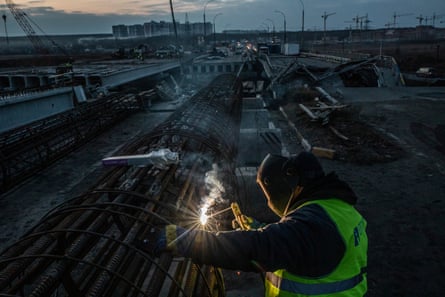
One of the most iconic images of the war dates back to early March 2022. The photo featured hundreds of civilians crowded together under the remains of a key bridge that connected Irpin to the city of Bucha, which at that moment held those people suspended between life and death: on one hand, the Russian artillery advancing from the north; on the other, the safety on the road to Kyiv. A year on, dozens of workers have nearly completed its restoration.

Workers on the bridge that connected Irpin to the city of Bucha

In the last year, Ukraine has cleared debris from 2,100km of roads, of which it has repaired 120km, rebuilt 41 of 330 destroyed bridges, created 80 temporary passages and renewed 900 railway points, such as train stations and train depots.

“When we’re talking about transportation, there are a few key tasks we’re trying to achieve,” says the deputy minister of infrastructure, Oleksandra Azarkhina. “First is to prevent a humanitarian crisis inside the country, and second to prevent a global food crisis. Restoring the principal transportation routes it is also crucial to continue to supply our frontlines. Are we aware that what we have rebuilt could be destroyed again? Yes, but it is a risk that we’re forced to take. And frankly speaking, rebuilding is also part of our resistance”

As of January, Kyiv School of Economics reported a total of 149,300 residential buildings damaged, 330 hospitals, 595 administrative buildings and more than 3,000 schools and university buildings.

The building work completed so far has been paid for out of Ukraine’s cash reserves, and from an initial $600m payout from the European Investment Bank, which approved a second package of €1.59bn (£1.4bn) in July 2022.

According to the latest evaluation, Ukraine’s reconstruction and recovery needs have reached $411bn, the World Bank said. However, the estimate is constantly growing due to the continuous bombing and because no reliable data is available in the occupied territories. Ukraine’s prime minister, Denys Shmyhal, has said the cost of rebuilding could reach $750bn.

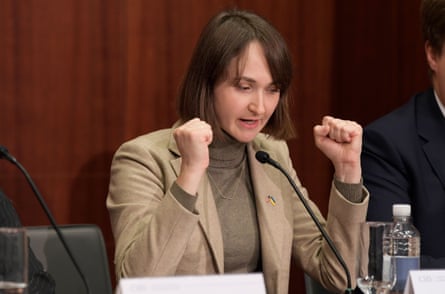
Oleksandra Azarkhina, Ukraine’s deputy minister of infrastructure
Oleksandra Azarkhina, Ukraine’s deputy minister of infrastructure. Photograph: Lenin Nolly/NurPhoto/Rex/Shutterstock

“The overall damage is terrible and not everything which was destroyed will need to be rebuilt,” says Azarkhina. “The country changed, the population moved. We need to be wise in using this money. But let’s not forget that Ukraine didn’t destroy its infrastructure, Russia did; they are the bad guys and they need to pay for that.”

International media have been asking how realistic Russian reparation payments are. In February, Poland and the Baltic states urged the EU and western governments to use Russia’s €300bn (£266bn) of frozen central bank reserves to start rebuilding the country. But experts have argued that redeploying Russian assets would breach international law.

Azarkhina says Ukraine has frozen several hundred million euros of Russian assets in the country, citing how Kyiv’s justice minister is working to settle legal issues in order to use the money to rebuild private houses.

An essential part of the reconstruction will also be paid for by private foreign investment. Many of the destroyed businesses will not be resurrected simply by repairing the buildings that housed them should Ukraine win the war, while thousands of Ukrainian soldiers returning to their cities from the frontlines will need work.

“We need to create employment,” says Sergiy Tsivkach, the CEO of UkraineInvest, Ukraine’s investment promotion office, “to transform the country from an exporter of raw materials into a prosperous European state with a developed industry.”

Tsivkach says he has already received numerous requests from foreign companies and dozens of projects are already under way, but some investors are still wary.

There is not only the issue of investing in a country still under bombardment. Another problem is the widespread corruption that has plagued Ukraine since independence. Transparency International ranked Ukraine as the second most corrupt country in Europe in 2021, behind only Russia.

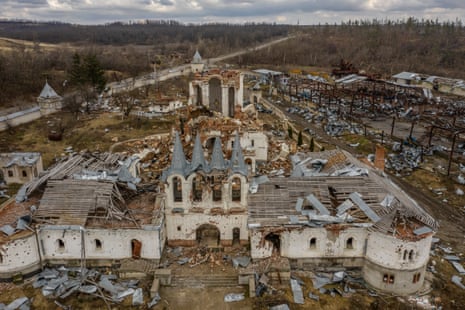
A church destroyed by the Russian forces in Dolina
A church destroyed by the Russian forces in Dolina. Photograph: Alessio Mamo/The Guardian

“The international community should be very afraid of how corruption might compromise reconstruction, and it should begin immediately to take measures to combat it,” says Bowser, who has worked for 25 years on governance and anti-corruption programs for various donor organisations. “Corruption is still endemic there.”

With Ukraine taking its first steps to EU accession, the government is under pressure to show it has cleaned up its act. In the last few months, dozens of senior officials have been sacked and Zelenskiy has declared a zero-tolerance approach.

“Ukraine made significant steps recently,” says Tsivkach. “In the past, we had many scandals. We have seen them on TV, but we did not see proper enforcement following these scandals. What’s happening now is that we see a case of corruption and a quick reaction from thestate to press charges against those responsible.”

However, much remains to be done. “One of the lessons I have learned from being in Ukraine is that there is a new cadre of voices who are serving on the frontlines who won’t accept passively sitting by while the country is looted again,” says Bowser. “One million Ukrainian veterans returning from the war, with missing limbs, who bled for this country, are not going to accept things as they were before 2014.”

“These people,” Bowser adds, “they won’t be throwing corrupt officials into garbage cans like they did in the past, but hanging them from lamp-posts.”

The ‘Marshall Plan’ is cancelled: How the IMF sees Ukraine’s post-war recovery

And why there is little hope for explosive growth in foreign investment

Every loan agreement between Ukraine and the International Monetary Fund (IMF) is accompanied by a memorandum. It is a document that describes in detail the economic realities of the debtor (which is Ukraine), as well as the obligations that our country has undertaken to the Fund.

In general, the IMF is quite conservative about the prospects of the Ukrainian economy. The main problem is that Ukraine is deeply mired in debt and will need hundreds of billions of dollars to eliminate the consequences of the war. Although the Fund, along with other international partners, is ready to provide financial support, the Ukrainian authorities will have to make enormous efforts to mobilise domestic resources for post-war economic recovery and create fertile ground for investment.

Mind has looked into the main points of the memorandum with the IMF and what the new $15.6bn loan from the Fund obliges Ukraine to do.

Key macroeconomic forecasts from the IMF. Several dozen pages of the memorandum are devoted to the situation in the Ukrainian economy and an assessment of its key indicators. In general, the forecasting horizon covers the period up to 2030. However, since the IMF-Ukraine cooperation programme is designed for four years, we will analyse this period in detail.

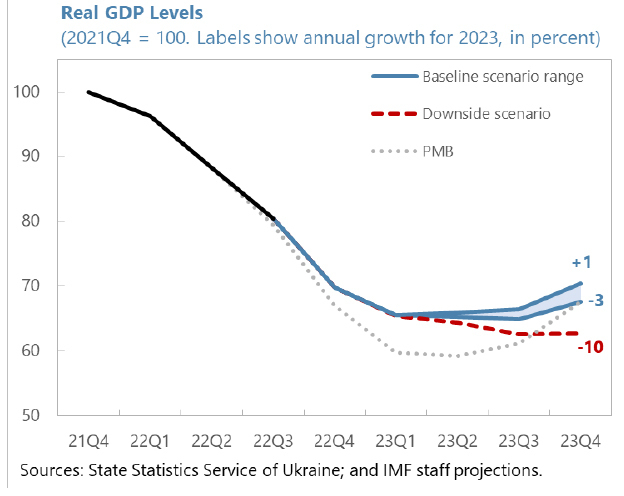
1. Economic growth will start accelerating no earlier than 2025. In 2023, according to IMF estimates, Ukraine’s GDP will fall by another 3% at worst (after falling by more than 30% in 2022), and at best it will grow symbolically by 1%. In 2024, GDP growth will be 3.2%, and in 2025-2027 – 6.5%, 5% and 4%, respectively.

Ukraine’s GDP growth forecast (baseline and adverse scenarios)

«План Маршалла» скасовується: яким бачить МВФ післявоєнне відновлення України

Source: IMF data

2. Inflation in 2023 (year-on-year) will be 20%, which is not much less than in 2022 (26.6%). Consumer price growth will not reach its target level of around 5% per annum until 2027.

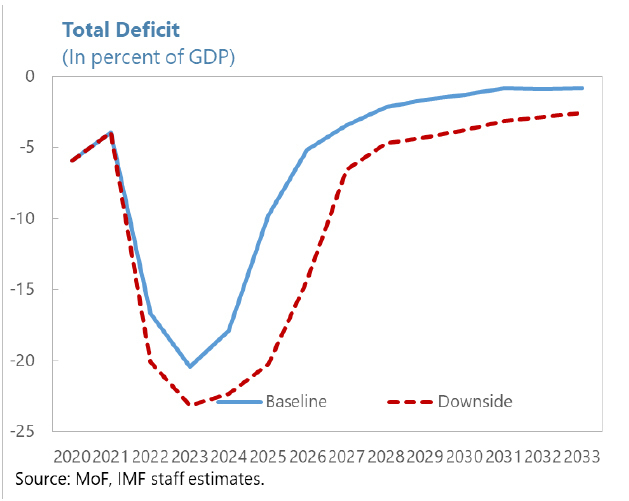
3. The state budget deficit will be significant for quite some time. For comparison, let’s take 2021 as a starting point, when the budget deficit (excluding external grants) was 4% of GDP. In 2023, the deficit to GDP will be 28.2%, in 2024 – 22%, in 2025 – 12%, and only in 2026-2027 will it be reduced to almost pre-war levels of 4.6-6.5% of GDP.

Forecast of the state budget deficit of Ukraine (baseline and adverse scenarios)

«План Маршалла» скасовується: яким бачить МВФ післявоєнне відновлення України
Source: IMF data

4. Due to this deficit, Ukraine will continue to be heavily dependent on external financing. In 2023, its volume to GDP will be 19.8%, in 2024 – 17.7%, and in 2026 – 9.5%. At the same time, the IMF forecasts that in 2023, Ukraine’s public debt will exceed 98% (82% in 2022), and in 2024 it will exceed 100% and remain above this limit until 2027 inclusive.

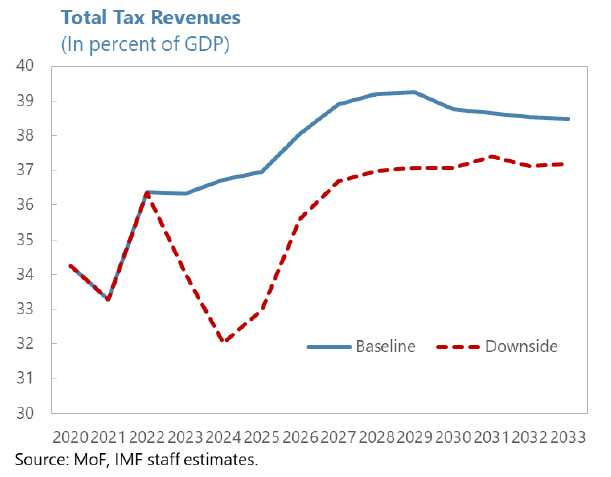
5. Tax revenues will be in the range of 36-39% of GDP in the next few years. The tax part of the state budget revenues will be made up of personal income tax and corporate income tax (10-12% of GDP), as well as consumption taxes, primarily VAT and excise taxes (13-15% of GDP).

Forecast of tax revenues to the Ukrainian state budget (baseline and adverse scenarios)

«План Маршалла» скасовується: яким бачить МВФ післявоєнне відновлення України

Source: IMF data

6. Foreign trade will remain deeply in deficit. The negative balance of export and import of goods will grow from $25 billion in 2023 to $35 billion in 2027. The reason is that import will grow at a rate that outpaces export growth. The reason is that it will take a lot of money and time to rebuild the destroyed industries. Therefore, according to IMF estimates, the foreign trade deficit will not be significantly reduced even by 2030.

7. According to the Fund’s calculations, Ukraine should not expect an investment boom either. Foreign direct investment in 2023-2024 will amount to 0.4% of GDP at best, 2.4% in 2025, and close to 5% in 2026-2027.

The IMF’s alternative ‘bad’ scenario indicates that the state of the Ukrainian economy directly depends on how the situation at the frontline develops. Moreover, based on the baseline scenario, on which all the above forecasts are based, the end or at least the decline in hostilities should occur in mid-2024.

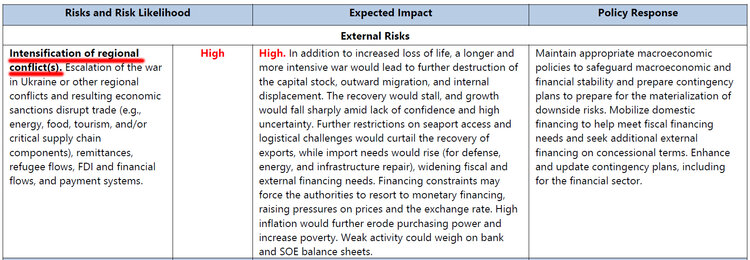
At the same time, the fund believes that the risk of further escalation of the military conflict is extremely high, which in turn will lead to a deterioration in the macroeconomic situation. These include new destruction of production facilities, disruption of supply chains, stagnation of foreign trade, another wave of refugee outflows abroad, and a complete freeze on investment (although there is none anyway).

Risk of escalation of the military conflict in Ukraine and its consequences

«План Маршалла» скасовується: яким бачить МВФ післявоєнне відновлення України

Source: IMF data

In this case, the second, unfavourable scenario for the Ukrainian economy could be realised. This scenario implies that the GDP decline will continue, reaching 10% in 2023 and 2% in 2024. GDP growth of at least 4% is possible no earlier than 2027. Inflation will accelerate to 32.5% in 2023 (year-on-year) and 20% in 2024.

The state budget deficit will increase to 35.4% of GDP in 2023 (excluding grant support), and will decline slightly to 32.2% in 2024. Ukraine’s external financing needs in 2023-2024 will be at 21-22% of GDP. It is twice as high as in 2022.

The total financing gap under the adverse scenario will reach about $140 billion, which is about $25 billion more than under the baseline forecast for 2023-2027. The IMF does not exclude that extraordinary measures will have to be taken in this case. These may include new types of taxes (a surcharge on the current personal income tax rate, additional excise duties, etc.), as well as administrative intervention by the NBU in the domestic debt market, which will be manifested in the obligation of banks to buy back a certain amount of domestic government bonds to finance the budget deficit.

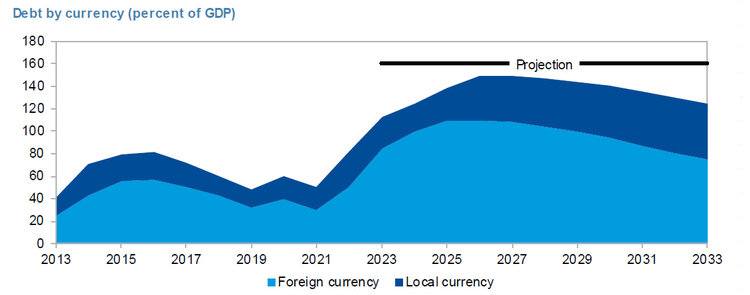
Thus, the second, unfavourable scenario could set back Ukraine’s economic recovery by at least two to three years. And its dependence on external financing would increase even further, as the level of public debt could reach 150% of GDP by 2026-2027.

Public debt forecast (adverse scenario)

«План Маршалла» скасовується: яким бачить МВФ післявоєнне відновлення України

Source: IMF data

The IMF’s ‘homework’ for Ukraine and its purpose. Ukraine’s commitments under the IMF’s new loan programme are largely focused on ensuring current and medium-term fiscal stability, as well as preparing the ground for post-war economic recovery.

The Ukrainian side, in particular, has committed to take measures to expand investment opportunities, strengthen the energy sector, return to a flexible exchange rate, reduce dependence on external financing, and bring Ukrainian tax legislation closer to EU legislation once active hostilities have abated. The widespread fight against corruption is also mentioned as a ‘beacon’. However, it is a traditional point that appears in every new memorandum.

By the summer, the parliament should vote on draft law No. 8401, which provides for the abolition of the 2% preferential rate for single tax payers (it was introduced in March 2022), the resumption of full-fledged tax audits and the return of fines for businesses for violations related to the use of payment transaction recorders (PTRs). The Cabinet of Ministers and MPs also need to solve the issue of accumulating tax arrears that amounted to 1.5% of GDP at the end of 2022.

At the same time, the Ukrainian authorities assured the IMF that there would be no measures aimed at “reducing and undermining tax revenues” in the coming years. In other words, no lower rates and no exemptions.

Furthermore, plans to eliminate tax avoidance practices through the simplified taxation system (the so-called salaries of individual entrepreneurs), to completely cleanse the tax and customs authorities of systemic corruption, and to strengthen the fight against tax evaders (the Bureau of Economic Security is to be rebooted) are among the priorities for filling the state budget in the post-war period. Tax reform is also planned to “balance the need to ensure the revenue base of the state budget with the interests of business and investors”.

As early as 2023, Ukraine will move to medium-term budget planning and will make a separate forecast of budget revenues and expenditures for 2025-2026 when preparing the draft state budget for 2024. A public debt management strategy should be ready by September 2023.

In short, Ukraine is committed to strengthening the domestic debt market, attracting not only banks (currently one of the main buyers of government bonds) but also non-residents. The goal is to prevent emission and reduce the state budget’s dependence on external aid, replacing it with domestic financing.

At the same time, the Ministry of Finance will prepare and submit the National Revenue Strategy for 2024-2030 to the Cabinet of Ministers for approval. It is a comprehensive document that will contain the main principles and directions of fiscal (tax, budget, debt) policy. The strategic goal is to accumulate all possible resources for post-war recovery.

We will have to do everything on our own. The main conclusion to be drawn after analysing the memorandum with the IMF is that we should not expect rapid economic growth after the war is over. At the same time, Ukraine needs to prepare for a long and difficult recovery. In more detail, the main results are as follows:

  • The best-case scenario is a cessation of hostilities (or their suspension) around mid-2024, while the worst-case scenario is a prolonged war that could last for years and destroy the Ukrainian economy.
  • Even with annual economic growth of 3-4%, by 2027, Ukraine will reach 75-80% of its GDP in 2021. Thus, we still won’t be able to return to the pre-war state in five years.
  • Unfortunately, we should not rely on external investors. International assistance (from the IMF in particular) is intended mainly to balance the state budget. At the same time, the volume of FDI, according to IMF estimates, will be in the range of $5-10 billion per year. It is very little, given that Ukraine’s direct losses due to the war alone, according to the Kyiv School of Economics (KSE), amount to almost $140 billion.
  • It all comes down to the fact that the country will have to rebuild itself largely on its own. Of course, the economy cannot be restored on government bonds alone. Consequently, the role of the state apparatus will be strengthened, on the one hand (expanding the powers of supervisory authorities), and fiscal pressure (tax increases) will increase, on the other. Moreover, it is likely that many tax innovations will be presented under the pretext of the need to reform the tax system for Ukraine’s accession to the EU.

https://mind.ua/en/publications/20255748-the-marshall-plan-is-cancelled-how-the-imf-sees-ukraines-post-war-recovery

REBUILDING UKRAINE WITH THE PRIVATE SECTOR

For over a year, Ukraine has faced unprecedented challenges due to
full-scale military aggression against our country. Nevertheless, we remain
steadfast in our defense of territories and continue to conduct business.
UkraineInvest, the government’s investment promotion office, has continued its operations throughout this period without interruption.

Currently, we are supporting 17 investment projects worth over $2.3 billion
and providing ongoing business support to both Ukrainian and foreign
companies operating in Ukraine.

Promoting investment opportunities is a top priority for us. Investors can
start planning their investments today. There is no need to wait until the
end of the war.

Our message to the international business community is clear: Ukraine is
not only strong and free, but open for business.

We proudly present the UkraineInvest Guide, an essential source of
analytical information for companies doing business in Ukraine or planning
to invest

FULL INFORMATION HERE – Guide (16.03) (ukraineinvest.gov.ua)

Asters, Ukrainian Wind Energy Association and Ukrainian Hydrogen Council present the White Paper “Offshore wind energy and green hydrogen: new frontiers of Ukraine’s energy potential”

Asters, Ukrainian Wind Energy Association and Ukrainian Hydrogen Council have published the White Paper “Offshore wind energy and green hydrogen: new frontiers of Ukraine’s energy potential”.

The publication targets the top management of the Ukrainian energy market players, as well as a wider audience interested in the development of renewable energy and decarbonization of the Ukrainian economy.

The White Paper analyses the potential for offshore wind energy development in Ukraine, as well as the use of wind energy for the production of green hydrogen. The authors have presented convincing arguments in favor of the development of this energy sector and have suggested relevant changes to the Ukrainian legislation to facilitate investments in offshore wind energy and production of “green” hydrogen. The White Paper (in Ukrainian) is available for download at Asters website >>

Oleksandr Repkin, President of the Ukrainian Hydrogen Council, and Kateryna Knysh, Head of Analytics at UWEA, have inspired the idea behind this White Paper. The White Paper is co-authored by: Stepan Kudrya, Director of the Institute of Renewable Energy of the National Academy of Sciences of Ukraine, Anzhelika Livitska, Counsel at Asters, Marta Halabala and Bohdan Shmorhun, Senior Associates at Asters, and Olena Sichkovska, Associate at Asters. Andriy Konechenkov, Chairman of the UWEA’s Board, and Asters Partner Yaroslav Petrov edited the White Paper.

“The development of offshore wind energy technology and green hydrogen production is directly related to strengthening Ukraine’s energy independence, fighting the global climate change and implementing the EU strategies,” – says Andriy Konechenkov, Chairman of the UWEA’s Board. “A result of the cooperation of leading national experts, this White Paper is the first Ukrainian-language analytical study of the potential of these new and promising areas of energy development in Ukraine.”

“Under favorable conditions, offshore wind energy and green hydrogen production can become extremely attractive sectors for foreign investments into the Ukrainian economy and strengthen Ukraine’s energy integration with the EU,” – Yaroslav Petrov, Asters’ Partner comments. “Asters experts are actively involved in improving the legal landscape for doing business in Ukraine. We hope that the key points of this White Paper will trigger a productive discussion on further development of the Ukrainian renewable energy market.”

* * *

Asters has extensive experience in advising clients on various significant energy related projects in Ukraine. Asters is a Band 1 law firm for energy and natural recourses by Chambers Europe 2021, a Tier 1 law firm for energy and natural resources by The Legal 500: EMEA 2020 and is ranked among the Top 3 law firms for energy and natural resources by Ukrainian Law Firms 2020. A Handbook for Foreign Clients

Ukrainian Wind Energy Association is a nonprofit organization aimed at promoting wind energy technologies and ensuring wind energy industry interests on the national and international levels. The UWEA links wind power project developers, wind power equipment manufacturers and suppliers, utilities, construction companies, scientists and researches, lawyers, NGOs, consumers and others involved in the wind industry.

Ukrainian Hydrogen Council is the first hydrogen energy association of Ukraine’s leading energy, industrial and public companies. Combined by the desire and understanding of the need: integration of modern renewable energy technologies into the Ukrainian economic model, modernization of the energy complex of Ukraine and introduction of sustainable development for the global transition to renewable hydrogen energy resources.

A year into the war, Ukraine and the West prepare for the biggest reconstruction since World War II

One year since the start of Russia’s full-scale invasion, Ukraine’s economy and infrastructure are in tatters, with the government and its allies planning the largest rebuilding effort since World War II.

The World Bank estimates that Ukrainian GDP shrank by 35% in 2022, and projected in October that the population share with income below the national poverty line would rise to almost 60% by the end of last year — up from 18% in 2021.

The World Bank has so far mobilized $13 billion in emergency financing to Ukraine since the war began, including grants, guarantees and linked parallel financing from the U.S., U.K., Europe and Japan.

The International Monetary Fund estimates that the Ukrainian economy contracted by 30%, a less severe decline than previously projected. Inflation has also begun to decelerate, but ended 2022 at 26.6% year-on-year, according to the National Bank of Ukraine.

IMF Managing Director Kristalina Georgieva visited Ukraine this week, meeting with President Volodymyr Zelenskyy and NBU Governor Andriy Pyshnyy, among others.

In a statement Tuesday, Georgieva said she saw “an economy that is functioning, despite the tremendous challenges,” commending the government’s vision to move from recovery to a “transformational period of reconstruction and EU accession.”

“Shops are open, services are being delivered and people are going to work. This is remarkable testament to the spirit of the Ukrainian people,” Georgieva said, also noting that government agencies, economic institutions and the banking system are fully operational.

“Notwithstanding the attacks on critical infrastructure, the economy is adjusting, and a gradual economic recovery is expected over the course of this year,” she added.
Georgieva reiterated the IMF’s commitment to supporting Ukraine, and the Washington-based institution has provided $2.7 billion in emergency loans over the past year. However, it is also working with Ukraine under an economic policy monitoring program, a precursor to establishing a fully-fledged IMF lending program, as Kyiv seeks a $15 billion multi-year support package.

“The international community will continue to have a vital role in supporting Ukraine, including to help address the large financing needs in 2023 and beyond,” Georgieva concluded.

“The war in Ukraine has had far-reaching consequences for the local, regional, and global economy. Only if we work together as a global community will we be able to build a better future.”

Massive infrastructure rebuild
At a G-20 meeting on Thursday, U.S. Treasury Secretary Janet Yellen called on the IMF to “move swiftly” toward the fully financed loan program, with Washington readying economic assistance to the tune of $10 billion in the coming weeks.

The U.S. has provided a cumulative $76.8 billion in bilateral military, economic and humanitarian aid to Ukraine between Jan. 24, 2022, and Jan. 15, 2023, according to Germany’s Kiel Institute for the World Economy.

This includes $46.6 billion in military grants and loans, weapons and security assistance, by far outstripping the rest of the world. The U.K. has been the second-largest military contributor at $5.1 billion, followed by the European Union at $3.3 billion.

As the conflict enters its second year and shows no sign of abating, with Russia increasingly attacking critical infrastructure and power shortages persisting, the Ukrainian economy is expected to contract again this year, albeit at a low single-digit rate.

A recent estimate from the Kyiv School of Economics put the total damage to Ukrainian infrastructure at $138 billion, while Zelenskyy has estimated that rebuilding the country could end up costing more than $1 trillion.

“Since the beginning of Russia’s war against Ukraine, at least 64 large and medium-sized enterprises, 84.3 thousand units of agricultural machinery, 44 social centers, almost 3 thousand shops, 593 pharmacies, almost 195 thousand private cars, 14.4 thousand public transport, 330 hospitals, 595 administrative buildings of state and local administration have been damaged, destroyed or seized,” the KSE report highlighted.

Meanwhile, Ukraine’s budget deficit has risen to a record $38 billion and is expected to remain elevated, though strong external support from Western governments and the IMF is likely, according to Razan Nasser, emerging market sovereign analyst at T. Rowe Price.

“This should help to plug the financing gap, which in turn should help to reduce reliance on monetary financing this year,” Nasser said.

In its January policy meeting, NBU officials discussed a number of measures aimed at avoiding a return to monetary financing of the budget deficit.

External creditors in August agreed to a two-year standstill on sovereign debt, acknowledging the immense pressure being exerted by the war on the country’s public finances.

“This will likely be the first step of the restructuring, with a deep haircut on the debt likely. It is difficult to predict the size of this debt reduction as it depends on the state of the Ukrainian economy at the time the restructuring is agreed,” Nasser said.

He added that a “political decision” will be needed on how much private creditors should contribute to the reconstruction costs in light of the colossal damage inflicted to infrastructure so far.

When this war does eventually end, the scale of the reconstruction and recovery effort is likely to eclipse anything Europe has seen since World War II,” he said.

This sentiment was echoed on Wednesday by Deputy Prime Minister Yulia Svyrydenko, who told Politico during an interview in Brussels that the reconstruction should start this year, despite there being no immediate end to the conflict in sight.

“It’s going to be the biggest reconstruction [since] World War II,” she said. “We need to start now.”

Although beginning the rebuild while the war is still ongoing and Russia continues to target civilian infrastructure might seem counterintuitive, Daniela Schwarzer, executive director of Open Society, told CNBC on Thursday that it was essential.

Ukrainians very clearly make the case that actually, reconstruction has to begin in some parts of the country while the war is still ongoing, because for the country, the destruction of infrastructure — which really happens every day — needs to be handled otherwise people can’t live, the economy can’t pick up, and so there’s a huge task,” she said.

“We will see over the next few months how international financial institutions, including the European ones such as the International Bank of Reconstruction and the European Investment Bank along with governments and the EU, plus the United States, but the next important question is how can private investments eventually be brought back to Ukraine, because governments alone can’t rebuild the country.”

Restoration of Ukraine: opinion by CSIS elite

On January 10, 2023, the Center for Strategic and International Studies (CSIS) held a presentation of the Report named Enabling an Economic Transformation of Ukraine. Recovery, Reconstruction, and Modernization. CSIS, as influential American think-tank with over 60 years of history, is involved in active discussion of the state and future of the Ukrainian economy. A feature of this organization is analysis of a variety of problems/challenges through the prism of security, geopolitics and American version of development policy. CSIS has direct, strong contacts with all branches of government, influences policymakers and decision-makers both in the USA and in many countries worldwide.

Nine months ago, CSIS created Ukraine Economic Reconstruction Commission. Presentation of the Report commenced with speech of Daniel F. Runde, Vice President of the Center, Director of the Prosperity and Development Project, who informed about the work that preceded publication of the Report. There were held 20 seminars on various themes, starting from agriculture and up to public administration. 500 people got engaged in work, including experts from Ukraine, resulting in ten papers. The Danish government financed the whole scope of works.

The speakers were Professor & Ambassador Paula Dobriansky, Ambassador William Taylor and well-known businessman, founder and CEO Invenergy Michael Polsky. Discussion touched mainly on the most general issues of security, legal institutions, public administration and investment opportunities. D. Runde clearly defined that reconstruction and transformation of Ukraine should be such that it would result in NATO and EU membership. He described very ambitious benchmarks of success as follows:

  1. GDP per capita, like in Poland,
  2. production capabilities/productivity in agriculture, like in Canada,
  3. industrial capabilities/performance, like in the Czech Republic,
  4. technology sector, like in Estonia,
  5. quality of public administration, like in Romania,
  6. military ability/quality, like in Israel.

Sergiy Tsivkach, CEO UkraineInvest, the first speaker, expressed full agreement with the presented Report, assured of the unconditional course of Ukraine’s current leadership to carry out institutional systemic market reforms. Sergiy Tsivkach emphasized that Ukraine has a zero tolerance towards corruption. Even those present at the presentation of the Report hardly agreed with this bravura hypothesis.

As expressed by the Ukrainian marketer of business opportunities in Ukraine, hundreds of companies from various countries are ready to invest in the country, to implement their own ideas, funds and production plans. However, there were no specific cases and figures. As an argument in favor of the current government’s intentions, he cited phrase spoken by Head of the State Property Fund, who said that everything would be privatized in Ukraine except dignity. Prior to that, he said that the country has made progress in privatization but cited no figures of revenues to the budget from the sale of state assets. Obviously, neither discussion of the main economic document upon Ukraine in the format of a business forum, on the one hand, nor security conference, on the other hand, is aimed at critical, scientific understanding of the formalized proposals.

Goals and ways to achieve them

The Report is quite optimistic. As stated by head of the European Commission, Ukraine has everything it needs for successful recovery, such as determination, vibrant civil society, many friends worldwide who want to support Ukraine, as well as impressively strong economic base. Such base has been developed in Ukraine since the early 1990s. But Ukraine feeds mainly 3-5% of its population, at the expense of the rest.

CSIS Report dated October 2022 shows a vision of Ukraine’s future: In 10 years, Ukraine will be a stable, Western-oriented democracy, tightly connected to the Euro-Atlantic world. Strong armed forces and EU membership will guarantee independence of Ukraine. Its economy will be transformed from a system dominated by oligarchs, vested interests and state-owned enterprises to a dynamic, innovative, open, inclusive and entrepreneurial system. Ukraine will meet high international standards, such as the Finnish level of military spending and involvement, the Japanese level of infrastructure development, the German style of industrial production, the IT sector based on model of the Baltic countries, the agricultural sector in terms of labor productivity and efficiency, like in Canada.

In the entire history of mankind, neither country has managed to go along such a super-difficult path just for ten years. With regards to post-Soviet heritage, quality of Ukrainian legal institutions, toxic influence of oligarchic structures, state of the intellectual field (with Marxism and left Keynesianism prevailing), as well as specifications of decision-making system in Ukraine, it is extremely problematic to reach the level of Poland, Czech Republic, Slovakia or Romania. With proposed model of the State, universal interventionism is impossible. The chance appears in case of launching a truly innovative, evidence-based economic and institutional policy. But in fact, situation in Central and Eastern Europe is not so rosy and not so high-quality: many of them have joined the European Union almost 20 years ago and have joined NATO ~25 years ago. And Ukraine, in some magical way, should complete the transit just in 10 years.

Authors of the Report are right that in Ukraine should create an environment that commercial structures will trust in order to invest and to modernize the country. They say, investment in small and medium enterprises (SMEs) will play a key role in providing options in the labor market for migrants to return and to participate in national economy. They are right in listing theses about the rule of law, intensification of privatization, independence of judiciary power, inefficiency of state-owned enterprises, importance of access to finance and investment in human capital. Of course, it is not enough to treat the Report as a valuable intellectual contribution to discussion about the necessary economic recovery program for Ukraine.

So, CSIS offers the following to achieve the stated ambitious goals:

  1. adopting multi-year, multi-billion dollar obligations with regards to financing programs aimed at restoration of Ukraine (USA, EU, G7). The EU should offer a clear schedule for Ukraine to become a full-fledged EU member at lest within 10-15 years: Any other schedule is not serious and could weaken Ukrainian resolution to pursue the necessary reforms.
  2. fixing the roles and liabilities of development agencies, international financial institutions, development finance institutions in order to avoid burdensome requirements or duplication of effort.
  3. prioritizing reforms that will improve quality of public administration and accountability of government in order to create an enabling environment for private investment in Ukraine aimed to support its economic transformation: Such reforms should be consistent with Ukraine’s commitments on the way to EU membership. There shall be a crucial reform of legal system, which should be corruption-free. It is also necessary to break the power of oligarchs and vested interests, to create a level playing field both for large, medium and small Ukrainian businesses and to facilitate an effective judicial system based on the principles of Western partners functioning.
  4. reducing risks for private investors by creating a pool of finance for economic development from the American International Development Finance Corporation (DFC), IMF, the World Bank, European development financial institutions amounting to $5 billion per year within five years.
  5. creating an environment of transparency and accountability in order to include local civil society support aimed to monitor procurement and investors, to prevent harmful effects and to verify applicants for participation in programs.
  6. prioritizing modernization, in particular, via digitalization, throughout the whole reconstruction period, in order to create transparent conditions, accountability, to assure both donors and private sector of progress towards creating a well-managed economy.

Now we have a long menu of good intentions and institutional wishes. Who will oppose the German industrial way, Japanese infrastructure, Canadian farming or Estonian IT? It is unlikely that in Ukraine, the EU, the USA, and indeed in any country worldwide someone will act in favor of increasing country risks, hiding information from citizens/business, managerial chaos.

Quality of economic recovery/modernization program is determined not by a set of correct, noble goals, but by scientifically based, historically proven, country-specific methods aimed to achieve the set goals. Here the programs differ from each other. We can judge their quality just by set of proposed instruments/actions/solutions.

Let us single out main parameters for assessment of particular program document upon launching systemic, institutional reforms:

  1. functionality, amount of resources/assets, powers and discretion of the State (or those who dispose of someone else’s property). The document should clearly fix dynamics of the following indicators: 1) incomes/expenses of government bodies, 2) budget deficit, 3) public debt, 4) volume of regulatory burden, 5) volume of transaction costs, 6) share of labor force that receives income at the taxpayers’ expense, 7) inflation, 8) credit cost and distribution of interest rates between the beacon country and the reformer country. CSIS Report indicates nothing.
  2. dynamics of improving the country’s parameters in several leading indices and world rankings: Economic Freedom Index, Human Freedom Index, International Property Rights Protection Index, Global Competitiveness Index, Transitions Performance Index, Rule of Law Index, Innovation Development Index, Legatum Prosperity Index, Corruption Perceptions Index and many others. CSIS Report mentions nothing.
  3. structure of economic power: state business, large, small, metropolitan, regional, as well as degree of capital concentration in real and financial sectors. CSIS experts do not give clear answer to this question.
  4. dynamics of institutional, macroeconomic development parameters in terms of the following indicators: gross domestic product, GDP per capita, labor productivity, average/median wages, employment, unemployment, investment volume, foreign direct investment volume, export/import volume, savings volume and many others. CSIS Report specifies nothing.
  5. dynamics of social parameters: demography, life expectancy at birth, life expectancy after 60 years, life satisfaction, level of trust, number of healthy life years, fertility and many others. CSIS Report does not contain such information.

One can think that authors of this document were diplomats, lawyers, policymakers, security experts and delegates of associations and PR structures to attract investors. The gaping lack of specificity cannot be hidden by hackneyed phrases and sentences, such as: To carry out reform of the public administration system, anti-corruption reform, reform aimed to secure the rule of law, as well as legal reform, reform against money laundering, reform securing mass media independence, or: To stimulate the process of investment climate improvement, which facilitates growth of the Ukrainian media and attracts additional foreign investment, adopts clear rules of the game: Ukraine should go on improving the overall regulatory environment for creating new businesses, especially SMEs.

Here are more examples of formalism and programmatic blank noise: To continue get focused on privatization of state-owned enterprises, conducting their corporate governance in accordance with OECD principles aimed to reduce corruption and to improve overall economic efficiency, or: To improve and to update infrastructure in accordance with EU standards, by choosing trustworthy partners that will allow Ukraine to join the EU and to strengthen mutual complementarity with NATO.

In the framework of legal reform and public administration system improvement, CSIS recommends the following:

  • to adopt procedure for selecting judges of the Constitutional Court, with regards to the Venice Commission standards;
  • to strengthen combating corruption,
  • to bring Ukrainian legislation in line with international anti-money laundering standards;
  • to apply anti-oligarchic law;
  • to bring laws on mass in line with EU standards,
  • to reform legal framework for national minorities.

But hasn’t Ukraine been doing all this for the last 15-20 years? Hasn’t Ukraine created a whole network of structures aimed to combat corruption? Did it help in a situation where huge economic power and objectively corrupt instruments of nomenklatura discretion subordinate to VIP managers and consumers of someone else’s property?

Hetmantsev and CSIS: birds of a feather?

The Report has quite complimentary opinion concerning national recovery plan at the governmental level, known as the Lugano Plan (July 2022). This document, managed by of D. Hetmantsev, is deemed rather as a matrix for using ca. $750 billion of foreign aid, grants, loans and investments, not a full-fledged plan aimed at systemic modernization of the country and creation of new competitive institutions. Its implementation would not allow creating a full-fledged market structure of the economy but would reproduce the nomenklatura-oligarchic model.

However, CSIS treats the Hetmantsev’s Plan as a responsible attitude to economic policy. Both two documents are similar in abundance of bright slogans, formal declarations, emphasis on noble, wise, responsible and honest VIP-managers disposing of someone else’s property as the main drivers of development and growth. Both documents, as well as the reports drafted by the UN, IMF, state development agencies, ignore theory and practice of state failures, jointly with model of entrepreneurial growth. The reason for this synergy is obvious: it is a single theoretical matrix promoted and pumped-out by Western mainstream universities worldwide.

One thinks that authors of the Lugano Plan and the CSIS document are people of very similar political and ideological orientations within the theoretical school of development economics. Its recommendations are based on the growth theories proposed by Harrod-Domar, Solow-Swan and are partly based on P. Romer’s model of endogenous growth. Most such developments were offered to poor, developing countries in the first half of the 20th century. They cover instruments and institutions for all-encompassing state interventionism. They even provide for small and medium business development via preferential loans, subsidies, grants, tax preferences, that is, it is prerogative of the State.

The Americans (CSIS) neither browsed the Lugano Plan essence nor critically assessed theory and practice of the poor country development for over 70 years. This would require for deep audit of economic reforms in over 100 countries worldwide. They were carried out at the assistance and under the leadership of IMF, the World Bank and international development agencies/companies.

It is very difficult to find successful cases in the framework of general interventionism model, but there are lots of high-profile failures. Windows of opportunity (after termination of the war, political crisis, revolution) appeared in dozens of states, such as Afghanistan, Iraq, Serbia, South Africa, Tunisia, Moldova, Kyrgyzstan, Egypt, Turkey, Argentina, Mexico, Sri Lanka, Brazil, where international assistance to develop a reform program was based on development economics matrix. In fact, it was also launched in Ukraine both after the Orange Revolution and after the Revolution of Dignity. In 2019-2021 the Government of Ukraine also pursued a policy of active state dirigisme, artificial stimulation of demand and nationalization of investments.

Again, we fall into the same trap twice. Both D. Hetmantsev and CSIS (there is a mutual penetration of experts) see the future of Ukraine as several nomenclature-commercial projects owned by VIP-managers, consumers of someone’s else property and external partners in development/canalization of funds/assets. If any other people do the same but within the old system of authorities, motivation of officials and functionality of the State, why are the Lugano Plan authors and CSIS experts expecting to get a different result? The Report contains neither theoretical nor statistic nor essential grounds for such presumption.

CSIS experts fancy the Lugano Plan. They call it bold and wide-ranging, bringing sustainable economic growth and people’s well-being. Principles of the Plan are good for PR campaign as political slogans, as set below: 1) rapid onset, gradual development; 2) fair increase in welfare, 3) integration into the EU, 4) build back better, 5) stimulation of private investment and entrepreneurship. Does anyone understand what the tax & regulatory burden and inflation will be if such slogans are implemented?

Representatives of the Lugano Plan potential donors adopted their own seven principles for participation in reconstruction and modernization of Ukraine: 1) partnership, 2) reform process, 3) transparency, accountability and the rule of law, 4) democratic participation, 5) involvement of interested stakeholders, 6) gender equality and inclusiveness, 7) sustainability.

These principles have been adopted by Ukraine and other member states, as well as by multilateral institutions in Lugano. They will serve as grounds for further recovery of Ukraine, states CSIS in the Report. It notes that implementation of these principles will facilitate the EU membership in Ukraine and economy transformation.

Growth points again: subjectivity and favoritism

Authors of the Report support the slogan description of the Ukrainian economy in future: brains, hands, and grains, as defined by Olena Kosharna, head of Horizon Capital. It means that the Ukrainian economy in future will be based on high technologies in industry, digitalization and the IT sector, as well as agriculture: She notes, Such comparative advantages are built on a solid economic foundation. Done right, they can be the source of significant, fair economic growth for years to come. CSIS highlights that focus on such three economic areas will offer clear opportunities for successful integration of Ukraine into the EU economy, as well as its trading partners, such as the United States.

We have a typical example of theorizing and nomenclature allocation of so-called growth points, formation of national champions in manual mode: this is how scientists/analysts from Washington, Brussels, Berlin, Paris and Rome allegedly see the Ukrainian economic structure in future. Therefore, such structure will be the result of investment, production, management decisions of VIP-managers and consumers of Ukraine and donor countries.

With rare exceptions, almost all poor developing countries, both democratic and authoritarian ones, got keen on so-called growth points. Theorists cultivated such an opinion among policymakers and decisionmakers that if half of their income is taken from citizens through taxes, if such funds are channeled into strategically important and promising projects, if resources are nationalized and investments are made via large state-owned enterprises, the rate of economic growth will increase significantly and catch up with developed countries will get faster.

Among those who dispose of someone else’s property, few were able to resist the drug with conditional slogan Five Years in Three, especially when it was presented as a valuable, highly effective supplement without side effects. In the second half of the 20th century, absolutely all poor countries got keen on such stimulant. Then, through crises, bankruptcies, defaults, debt holes and corruption, everyone understood risks and threats of such a model as the state of general interventionism. Many low-income countries have been stuck in a poverty trap for decades.

Policymakers from post-Soviet countries, including Ukraine, also zealously took up manual management of business cycles, with the following main instruments applied:

  1. in monetary policy: interest rates, conditions for access to credit and currency, special reserve requirements, insurance;
  2. in fiscal policy: tax incentives/exemptions, tax holidays, special tax payment regimes, budget subsidies, grants;
  3. in regulatory policy: licensing, certification, obtaining permits, quotas, preferences in public procurement, export/import mode.

A gross mistake of the Government’s cyclical and countercyclical policy was that the market/natural business cycle was based on a starting point having no market and economic nature, i.e. post-Soviet structure of a planned economy. First, it was necessary to create this market structure of the economy, not to commit methodological deception.

Ukraine still does not have a full-scale market structure of the economy, which would further result in free, voluntary choice of business entities within their private property. Therefore, post-war reconstruction gives us such a unique historical chance.

Public sector still remains a burden of the Ukrainian economy. It preserves assets and ways of the state plan. The state is still the largest owner of resources and assets, including in the money market. Before outbreak of the war, those who disposed of someone else’s property processed 42-45% of GDP annually, while in 2022 total government spending reached nearly 75% of GDP. The war destroyed old structure of production and consumption, employment and savings. Under such circumstances, it is just subjectivity and favoritism – to identify so-called growth points (sectoral, individual etc.) and to create a special financial, tax, customs and regulatory regime for them. In view of economic science, such approach to economic policy is inessential and impractical. Unfortunately, such approach applies very rarely when discussing a country development strategy within development economics, especially in view of further prospect to use hundreds of billions of dollars of someone else’s monetary assets.

Authors of the Report have a declarative approach to defining sectoral priorities. Agriculture – certainly! Since it is so big and important, its development and support is first and foremost – but either for everyone or only for large enterprises having powerful lobbyists?

IT sector – no doubt! Let digitalization combat corruption and inefficiency of public administration system. But what should we do with multi-thousand functionality of the State?

Industry – that is a must! Due to launching German, Italian, French businesses Ukraine will turn into a powerful hub in the framework of global value chains. It is curious fact that such a crucial section of the Report as Manufacturing covered just 14 rows among 47 pages.

Power – yes, of course! It is a keystone: for 12 years before outbreak of the war, Ukraine received ca. $12 billion in renewable energy investments. Installed capacities could generate up to 60 gigawatts of solar energy, 320 gigawatts of onshore wind energy and 251 gigawatts of offshore energy, but the aggressor state paralyzed the use of this potential. Obviously, no proper attention was drawn to security risks. The Report contains no clear and explicit recommendation upon creating a full-fledged power generation private market from those competing in equal legal, tariff and price conditions.

Who will be liable?

CSIS states that the International Monetary Fund (IMF) will play crucial role in supporting macroeconomic stability during the recovery phase. The Fund is expected to help Ukraine to restructure debts and to finance budget programs. The World Bank should use its full potential to finance infrastructure, while IFC and MIGA will help Ukraine to attract private investors. The European Bank for Reconstruction and Development (EBRD) is also treated as an institution to support projects in infrastructure, energy and SME development.

Development agencies of G7 countries will finance technical expertise in public administration reform, launching the rule of law, anti-corruption and business climate. Although funding conditions are important, they should be introduced smartly, not in the name of the conditions themselves. In 2014 after the Revolution of Dignity, numerous bilateral and multilateral institutions put forward over 400 terms and conditions for Ukraine. This is unacceptable. Therefore, CSIS invites participants to recover the Ukrainian economy in order to get focused on such industries as public administration, the rule of law, combating corruption, trade liberalization, bringing laws, rules and regulations in line with EU standards.

At first glance, everything looks beautiful and dignified on paper – something close to perfect harmony of interests, missions, motives of dozens of international structures from various countries worldwide. Before that, all of them were able to agree only to global warming, gender balance and biodiversification. Even before holding their conferences in Bali or in another comfortable, very expensive place somewhere in Africa, Asia or Latin America. Here we are talking about real and large monies. There are high risks that each organization will dogmatically pursue its policy without response to actual state of affairs and the agenda of others.

The challenge of synchronization and cooperation within one international team is even more serious when we add a Ukrainian link to the overall system. Ukraine will be represented by a certain Mr./Mrs. Restructuring with a clearly defined moral and value position, profound scientific knowledge and a clear idea of what to do. Delegates from Ukraine will be various people with their own interests, views on the future and on the harmony of balance of interests/resources.

A sort of Hetmantsev or another similar policymaker may become a key decisionmaker from Ukraine. His/her proposals from the Lugano Plan are unlikely to raise serious objections from CSIS, IMF, MIGA or EBRD. IMF will clearly support tax increase for small and medium businesses, will object against reducing basic tax rates (VAT, income tax etc.), as well as will support progressive tax rates. This Fund does not support free market reforms but follows a certain macroeconomic matrix offered to our country in exchange for loans and technical assistance costs. In this scenario, it will be possible to forget about the reform in Ukraine, which means termination of dozens of thousands of individual entrepreneurs.

Lately IMF has praised the National Bank of Ukraine, recommending moving in this direction in the future. It means that average annual inflation over the past 20 years made up ca. 11%, for 25 it reached 30%. Figures for in 2022-2023 do not disturb the Fund. It is not particularly upset by scant credit market, as well as by the fact that Ukraine ranks last in the financial openness index worldwide. If IMF is the main institution for fixing Ukraine’s macroeconomic policy after termination of the war, deep reform of monetary policy can also be forgotten. If you do not believe, you may study a poor example of Argentina for the past 20 years. Today its inflation level makes up nearly 100% – in the footsteps of country programs launched by IMF, which has caused defaults, debts, corruption and acute shortage of economic freedom.

The World Bank, the EBRD also work in the same theoretical matrix at the IMF. The implementation of large investment projects in developing and transitional countries is not about reforms, but about joint business with VIP-managers of foreign and big business. Small business does not pull large investment projects in energy, utilities, transport, logistics infrastructure and banks. This means that international agencies and structures of the World Bank are doomed to work with large Ukrainian businesses, which will be recommended by representatives of Ukraine. If these are not commercial structures of the old oligarchs, then they can be firms of new VIP-managers of someone else’s property.

Out of the frying pan and into the fire, as proverb says. All these organizations have been working in Ukraine for over 25 years with varying intensity. Their theoretical basis, the content of their recommendations has been known for a long time. If so far (i.e. before outbreak of the war) they have not given the desired effect, have not put Ukraine on the way of rapid, long-term, inclusive economic growth, so why will such organizations, working by almost the same schemes/programs, with Ukrainian officials engaged of nearly the same quality as before, suddenly create an economic miracle? Clash of motivations, interests and expectations is obvious. Surely there will be informal negotiation platforms to coordinate interests. This is the new troubled water, where players of the Ukrainian and international back door deals and opaque scheme feel great.

International syndicate: harmful for the future of Ukraine

In early 2023, the situation in support of Ukrainian systemic economic reforms by international community is alarming, frustrating and causes serious concern. An analogy with weapon supply is appropriate. For a whole year, the US/EU/NATO has been assuring, promising, holding meetings, such as Ramstein, G7 and G20, while Ukraine is still without crucial weapon aimed to defeat the enemy. Every day of talks, every attempt to save Putin’s face once again – all results in daily death of Ukrainian heroes at the front and ordinary people under shelling of Russian fascists.

International stakeholders in recovery of Ukraine (American Center for Strategic and International Studies (CSIS), European Center for Economic Policy Research (CEPR), IMF, World Bank, EBRD, international consulting organizations such as Boston Consulting, Goldman Sachs or McKinsey, G7 and EU international development agencies) have relied on standard institutional, macroeconomic solutions. Their implementation resets the Ukrainian model of oligarchy/opaque scheme, preserves the model of the State of general interventionism in Ukraine, leaves a wide range of discretion (subjective interpretations of law provisions) in the hands of someone else’s property custodians. Such opinion is based on analysis of the following documents of joint Ukrainian-foreign stakeholders:

  1. Enabling an Economic Transformation of Ukraine. Recovery, Reconstruction, and Modernization, created by Center for Strategic and International Studies dated January 2023
  2. Restoration of Ukraine: principles and policy. Paris Report 1, created by Center for Economic Policy Research (CEPR) dated December 2022
  3. Country report on Ukraine No. 22/387, created by International Monetary Fund, IMF Country Report No. 22/387, Ukraine. Program Monitoring with Board Involvement, dated December 2022
  4. Plan of Ukraine’s Renewal or Lugano Plan, created by National Council of Innovation, Government of Ukraine, dated July 2022
  5. Macroeconomic Policies for Wartime Ukraine, created by Center for Economic Policy Research (CEPR) dated August 2022
  6. A blueprint for the reconstruction of Ukraine, created by Centre for Economic Policy Research (CEPR) dated April 2022.

The main delegates from Ukraine engaged in the above projects are Tymofiy Milovanov, Daniil Getmantsev, Yuriy Gorodnichenko, Natalia Yaresko, Ilona Sologub, Yegor Grigorenko, Vladislav Rashkovan, Veronika Movchan, Olena Pavlenko, Tatyana Deriugina, Olena Kosharna and Serhiy Tsivkach, all involved in the western mainstream, all speaking speak the same language with the IMF/EBRD/CEPR/CSIS. Most of them hold high offices in the Ukrainian government. All share principle approaches to economic policy based on the neo-Keynesian left and even Marxism; all defiantly ignore theory and practice of entrepreneurial growth with its main element, i.e. economic freedom.

All of them treat the State as the main business strategist, investor and designer of further structure of the Ukrainian economy; all keep contacts with large commercial structures – being further consumers of huge resources via projects aimed at restoration of Ukraine. There is another common feature that unites them all: none of them, in case of failure, will recover losses, no one will reimburse damages at his/her own expense, because they rely on management, consumption and disposal of someone else’s property.

Ukraine has already lost almost a year for radical, systemic reforms under war conditions. Specific proposals on the wartime economy were submitted to the Cabinet of Ministers, the Supreme Council and the Office of the President just in April 2022. Unfortunately, those forces that drafted the above plans and programs for Ukraine won. Their implementation means the only one: just missing once again a unique chance of Ukraine to become the New West, to liberate the entrepreneurial potential of millions of Ukrainians based on economic freedom.

Setting up and operating a joint venture in Ukraine

Structure 

Are there any particular drivers in your jurisdiction that will determine how a joint venture is structured? 

Typical drivers for joint venture structures are industry practice, regulatory framework and taxation. 

For instance, Ukraine has a long-standing practice of joint venture agreements for cooperation in the oil and gas industries, owing to certain tax considerations. Certain regulated business activities can only be conducted by legal entities that are registered in the designated form (eg, banks can only operate as a public joint-stock company). Owing to possible double taxation, joint venture parties sometimes prefer to cooperate as an unincorporated business in the initial stages before proceeding to a joint corporate entity. 

Since February 2022, IT businesses that comply with certain criteria can apply for registration as so-called ‘Diya City residents’ and enjoy a number of statutory preferences, including a special taxation regime, flexibility hiring IT specialists and governing their engagement, the possibility to conclude non-competition agreements, and implement debt-to-equity swaps, etc. 

Tax considerations 

When establishing a joint venture, what tax considerations arise for the joint venture parties and the joint venture entity? How can tax charges be lawfully mitigated? 

An incorporated joint venture is a taxpayer under the general rules (regarding corporate profit tax, value added tax (VAT), real estate and other taxes). Since February? 2022, IT joint ventures eligible for registration as so-called ‘Diya City residents’ can, instead of the general system of taxation with corporate profit tax (at 18 per cent), opt to pay capital withdrawal tax at the rate of 9 per cent. Small undertakings whose annual income does not exceed certain thresholds (approximately 7.5 million hryvnias in 2022) may enjoy preferential taxation regimes. 

In the wake of the Russia-Ukraine war, which started on 24 February 2022, the Ukrainian government introduced an alternative system of taxation for joint ventures earning not more than 10 billion hryvnia annually: for the duration of martial law, such businesses can choose to pay 2 per cent turnover tax instead of 18 per cent corporate profit tax. 

Temporary VAT and corporate profit tax exemptions exist in the cinematography industry, and in the space and aircraft industries. After 24 February 2022 and for the duration of martial law in Ukraine, most imports for defence purposes and humanitarian aid are released from import VAT and customs duties. 

An unincorporated joint venture is subject to separate taxation, for which special tax accounting regulations apply. The joint venture agreement shall define a (resident) participant responsible for the venture’s tax accounting and payment; this participant and the agreement are registered by the tax office. 

In-kind contributions (as opposed to cash contributions) of founders or participants into the (both incorporated and unincorporated) joint venture trigger Ukrainian VAT, subject to further tax credit and refund. 

Asset contribution restriction 

Are there any restrictions on the contribution of assets to a joint venture entity? 

The parties can agree on the contribution of any assets into an unincorporated joint venture. Importantly, the investments of the parties are deemed of equal value if the parties do not state otherwise in their joint venture agreement. 

There are restrictions on the contribution of certain assets to the capital of a separate corporate entity. The following cannot be used for the formation of registered capital: 

     – budget and loaned funds; 
     – bills (promissory notes); 
     – state (municipal) property that cannot be privatised; and 
     – state property that is under the operational management of a state-financed institution. 

Interaction between constitution and agreement 

What is the interaction between the constitution of the joint venture entity and the agreement between the joint venture parties? 

For unincorporated joint ventures, the joint venture agreement shall be registered with the local tax office for VAT purposes if the total volume of VAT transactions in the last 12 calendar months exceeds 1?million hryvnias. Additionally, the joint venture partner responsible for tax accounting is subject to a separate registration with the tax office. 

In incorporated joint ventures, the parties can enter into a corporate (shareholder) agreement determining certain aspects of their cooperation as shareholders. Such agreement is not subject to registration and may not contradict the joint venture’s constituent documents (charter). In case of a conflict, the constituent documents shall prevail. 

As of 2021, non-Ukrainian law may be chosen for a corporate agreement if at least one of the shareholders of the joint venture is a non-resident party. 

Party interaction 

How may the joint venture parties interact with the joint venture entity? Are there any restrictions? 

In an incorporated joint venture entity, the shareholders can participate and vote at general shareholders’ meetings and, therefore, interact with the joint venture by governing it on the most important issues. The shareholders only have access to a limited amount of information regarding the entity. 

Exercising control 

How may the joint venture parties exercise control over the joint venture entity’s decision-making? 

In an unincorporated joint venture, the parties may agree that all affairs are to be carried out jointly by all shareholders. In such a case, the consent of all shareholders must be obtained to execute each transaction. 

In incorporated joint ventures, the shareholders may exercise their will through participating in general shareholders’ meetings. 

In joint-stock companies, most issues on the agenda of the general shareholders’ meetings are resolved by a simple majority vote of all participating shareholders. However, in a private joint-stock company, the shareholders can agree to a bigger quorum (eg, unanimous consent of all present shareholders) for any issues except: 

     – the pre-term termination of the powers of the company’s bodies’ officials; 
     – the commencement of a claim against the company’s officials regarding the reimbursement of damages incurred by the company; and 
     – the commencement of a claim regarding non-compliance with the law in the case of a significant transaction. 

Therefore, a minority investor can have more power and control over a private joint-stock company. 

In a joint-stock company, a qualified majority (more than 75 per cent of the present shareholders) is required to adopt the following decisions: 

     – an amendment of the company’s charter; 
     – a cancellation of the bought-out shares; 
     – changing the type of the company; 
     – regarding the placement of shares; 
     – changing the registered capital; 
     – the issue of securities that may be converted into shares; and 
     – the termination of the company. 

In a limited liability company (LLC), as a general rule, all issues are decided by an absolute majority of votes. However, issues of changing the charter and registered capital, reorganisation or liquidation of the company require a qualified majority (at least 75 per cent of the total number of votes of participants of the company). Unless the company charter sets a lower number of votes (but no less than a majority), unanimous decisions of all participants are required for: 

     – the approval of the monetary assessment of a non-pecuniary contribution of a participant; 
     – the redistribution of the participants’ shares; 
     – the establishment of other corporate bodies; and 
     – the purchase of a participant’s share by the company. 

The minority investors are also entitled to demand internal and external audits. For instance, minority shareholders that hold over 10 per cent of a joint-stock company may request a special review by an internal auditing committee or a proper inspection of financial accounts by an independent auditing firm. 

Governance issues 

What are the most common governance issues that arise in connection with joint ventures? How are these dealt with? 

In an unincorporated joint venture, the parties are free to establish special procedures relating to adopting decisions and running the business in a practical manner, according to the terms and conditions of a joint venture agreement. 

The two most common governance issues that arise for joint venture corporate entities are the presence of a quorum and adopting decisions on specific issues. 

In the case of corporate disputes, the parties may resolve them in the courts or through arbitration tribunals. Shareholders have more freedom and flexibility to handle governance issues through shareholder agreements. 

Nominee directors 

With an incorporated joint venture, what controls exist in your jurisdiction in relation to nominee directors? How should a nominee director balance the potentially conflicting interests of the joint venture company and the appointing shareholder? 

In Ukraine, a majority shareholder (participant) usually nominates a director, but the former must act in the best interests of the joint venture company. 

In LLCs, supervision over the board of directors can be exercised by a supervisory board (if foreseen by the charter) or another corporate body appointed by the general shareholders’ meeting, or both. The general shareholders’ meeting may delegate certain powers to the supervisory board, including the appointment and dismissal or suspension of the board of directors. Moreover, shareholders that hold at least 10 per cent of the charter capital may initiate a financial audit of the company by an independent auditor. The board of directors is obliged to provide documents regarding the company at the request of the auditor. 

In a joint-stock company, the executive body is accountable to the general shareholders’ meeting and supervisory board (including its standing auditing committee). The general shareholders’ meeting can elect an auditing commission as a separate corporate body as well. In public joint-stock companies, an annual audit by an independent and certified auditor is obligatory. The board of directors is obliged to provide documents regarding the company at the request of the audit commission or an auditor. 

Competition law 

What competition law considerations are engaged by the formation and operation of the joint venture? Is approval needed? 

Assuming the turnover thresholds are met, the creation and operation of the joint venture may trigger the need to obtain certain approvals. Depending on whether a joint venture will be full-function or not, there may be a need for clearance of: 
     – merger: in the case of a joint venture’s creation, if operating permanently, all the functions of an autonomous economic entity (full-function joint venture) and such a creation will not lead to coordination of competitive behaviour between the parent companies of the joint venture themselves, or between the joint venture and its parent companies; or 

     – concerted actions: if a joint venture is established with an objective of, or results in the coordination of, competitive behaviour between the parent companies of the joint venture themselves or between the joint venture and its parent companies. 

Provision of services 

What are the key considerations in your jurisdiction in structuring the provision of services to the joint venture entity by joint venture parties? 

In an unincorporated joint venture, in the case of a simple partnership, the approval of all parties is needed for the execution of every transaction unless stated otherwise in the simple partnership agreement. 

In a joint-stock company, provision of services to the joint venture entity by joint venture parties (ie, its shareholders) may be recognised as an interested-party transaction if the transaction value exceeds 1 per cent of the company’s asset value, unless the company charter sets a lower value. The party interested in the transaction may be a shareholder (or shareholders or their affiliated persons) who alone or jointly owns 25 per cent or more of the company’s shares. Interested-party transactions with a value of up to 10 per cent of the company’s asset value require the approval of the company’s supervisory board and transactions with a value of more than 10 per cent of the company’s asset value require the approval of a general shareholders’ meeting. During the voting process, the shareholders interested in the transaction do not have the right to vote and a decision on this matter is made by a majority of votes of the non-interested shareholders present at the meeting. 

In an LLC, a transaction is considered an interested-party transaction if the other party is, inter alia, a shareholder (or shareholders or their affiliated persons) who alone or jointly owns 20 per cent or more of the company’s shares. However, it is entirely up to the shareholders to provide in the company charter for regulations concerning the need for pre-approval for interested-party transactions. All shareholders shall approve the relevant charter provisions unanimously. If the charter does not contain such provisions, no restrictions regarding interested-party transactions apply, except that such transactions shall be at arm’s length. 

Employment rights 

What impact do statutory employment rights have in joint ventures? 

Employees are entitled to all available statutory employment rights in joint ventures. Transferring the business will result in the automatic transfer of its employees to the new employer. At the same time, the mere fact of the business transfer may not serve as a reason for dismissal. In the case of transferring foreign employees, the employer must obtain a work permit prior to commencing the foreign party’s employment with a Ukrainian company. Under general labour laws, a transfer to another job in the same company and a transfer to another company, or other area or location, requires the consent of the employee concerned. However, in the context of the Russia-Ukraine war, after 24 February 2022 and during the validity of martial law, no employee consent is required in some instances (related to the liquidation of consequences of such aggression). 

In the case of non-incorporated joint ventures, employees will be employed directly by the joint venture parties. 

Intellectual property rights 

How are intellectual property rights generally dealt with on the creation, operation and termination of a joint venture in your jurisdiction? 

The parties of a non-incorporated joint venture can regulate issues of ownership and use of their intellectual property (IP) rights either in their joint venture agreement or in a separate agreement such as a licence agreement. The same applies to an incorporated joint venture. 

Economic (proprietary) IP rights may be transferred or assigned for ownership or use (eg, under a licence agreement) to an incorporated joint venture. On the termination of the joint venture, IP rights are dealt with in the same manner as any other proprietary rights; they are either sold (transferred) to third parties to pay off debts or distributed between the shareholders of the company. 

The Marshall Plan for Ukraine: open issues

For several weeks, the Ukrainian and world media have been discussing the plan for recovery of Ukraine, as called by journalists and economists the Marshall Plan by analogy with the well-known plan to help Europe after World War II.

It is extremely important for Ukrainian society to understand several key issues regarding this plan.

Strategic triangle

First of all, today Ukraine faces three priority tasks to be fulfilled:

  • Reconstruction: rebuilding destroyed infrastructure, housing and manufacturing to help a country recover from war.
  • European integration: acquiring the status of candidate, followed by membership of the European Union.
  • Modernization: a set of changes aimed to move the country to the next level of development.

Such three processes should be launched preferably in parallel. But the main problem is that they contradict to each other. It is not so obvious to everyone, so let us take a closer look.

Reconstruction requires for decision-making as soon as possible, preferably the cheapest ones. European integration requires for correct solutions that meet EU standards. Modernization requires for sustainable solutions, next-level solutions being expensive and slow. Such three factors cannot be implemented simultaneously; usually even two of them are inaccessible at the same time.

For example, there is a problem of destroyed housing. Reconstruction needs to give all those displaced by the war the cheapest and the simplest housing as soon as possible, in other words, housing in cardboard boxes for everyone. Such temporary solutions can define face of the Ukrainian cities for over a century, like previously Khrushchev-era apartment blocks facilitated housing for millions of people who lived in barracks, basements and dugouts. European integration does not allow such quick and simple solutions, because they may cause significant economic and social problems within a few years, starting with excessive energy consumption and environmental risks, up to ghettoization. Modernization in general needs, first of all, thinking over the demographic situation and demands of future Ukraine; therefore, it requires for making slow and balanced decisions. But if all the funds are spent on reconstruction, modernization will never happen.

Another crucial aspect of this triangle is economic freedom. Modernization requires for maximum economic freedom in order to include creative energy of millions of Ukrainian men and women, to give them an incentive either to come back or not to leave. On the other hand, economic freedom attracts foreign investments; without them a fundamental increase in labor productivity aimed to enrich the country is impossible. In turn, European integration requires for restrictions on economic freedom in order to comply with European rules and regulations, and there may be additional restrictions, because European governments will think first of all about saving jobs and programs aimed to support their own producers, especially in agriculture. Reconstruction does not take care of economic freedom at all: everything should be done as soon as possible so that everyone could have shelter, water or electricity, and if the same companies obviously win all the tenders, this is a small price to pay for recovery rate, as treated in the interests of reconstruction.

Such issues are not purely economic, they also affect other spheres, including politics. Reconstruction goes faster under authoritarian rule, but this approach makes European integration and even modernization impossible. European integration does not always mean modernization, because no one is particularly concerned in emergence of a new tiger economy. European integration without modernization will cause reaching the outskirts of Europe, while modernization without European integration will awake problems with finding markets and money; however, modernization jointly with European integration will launch an endless process without results. How to combine European integration with economic freedom, which even in its current limited version provides for Ukrainians innovative digital banking services and quality coffee, which not all the Europeans have?

Fast, cheap and high-quality: it cannot happen simultaneously. It is impossible to build a stable, open and efficient system. This is the so-called strategic triangle. But which one among three principal aspects should be sacrificed? European integration that gives us the desired access to markets, financing and stable rules? Reconstruction that promises quick overcoming devastation? Or modernization that gives us hope for a new country instead of the post-Soviet legacy?

The choice in strategic triangle will determine outlines of the processes for the next decade and format of the country for the next fifty years.

Structure of launching the plan

One more keystone is the following: who will control over the process? From one side of spectrum, there is desire of the Ukrainian authorities, which can be expressed roughly like this: we defeated Putin, you owe us, you should give us money and shall not ask for anything. One Western diplomat notes that momentary weakness of the West has passed, in other words, they have been observing us for 30 years and know the whole our structure. Another Western diplomat highlights that they will remember everything they forgave us, referring to regularly repeated deception of Western partners, when funds were allocated under promises of reforms, while in fact funds were spent and reforms were not carried out.

From the other side of spectrum, there is position of certain Western circles thinking that we will steal everything, so no one shall grant costs in our favor; therefore, we shall create a project office, with only American and European experts engaged who will sign all the receipts. Such an approach is unfavorable for Ukraine: it means that our Ukrainian vision, Ukrainian strategy and interests will be completely ignored, Ukraine will not be deemed as owner of the plan. This is an unfavorable situation that local anti-Westerners call external rule: old-timers are unable to solve their problems independently due to weak institutions. Obviously, in such case, funds will be spent for development of the donor-state economies, not our own economy. Certain representatives of the Ukrainian side even declared the following: you shall give funds to Ukraine, we will steal maximum 20%, while the remaining 80% will be used for development of the country, because if the funds are distributed on your side, 40-60% will be consumed by administrative costs, while Ukraine will get only the remaining share.

Two aforesaid extreme positions outline the spectrum, with numerous intermediate options (i.e. bad compromises) lying between them. After all, usually a compromise is a solution that does not suit either party. The solution is usually aimed not to seek a compromise between two extremes, but to reach an additional dimension, finding a solution of the next level of complexity. But one should understand that it will work more slowly.

There are more questions than answers!

The above two key questions are the most crucial and the most complex, but the problem covers not only them.

Who will be Number One in the process: the USA or the European Union? Obviously, there are different approaches and priorities. How to combine numerous international financial organizations with different rules and approaches into a single structure? How to secure balance between short-term (Ukrainian politicians always choose them because they think about the next elections) and long-term interests? How to balance three funding mechanisms: grant aid (obviously in restricted amount), loans (to be repaid later, but from which proceeds?) and investments in Ukrainian assets (now greatly undervalued, which contradicts to the Ukrainian business interests). How to combine reconstruction/European integration/modernization with solving security problems? Security problem was solved by the Western European Countries after World War II and by the Eastern European Countries after the fall of communism, both with NATO assistance. But we will have to bear our own liability for on a significant part of this task.

Special attention should be drawn to one of the most vital questions: what will be economic policy of post-war Ukraine? Can we significantly raise economic freedom, rising from the current 130th place in global rating and making the country attractive for domestic and foreign investments? Will it result in victory of supporters of increased state regulation, socialist approaches and leading role of the state in economy? That is why Ukrainian business recently declared its clear position and principles (see. Memorandum of the Coalition of Business Communities for the Modernization of Ukraine).

It is gratifying that Western policymakers, trained by Ukrainian deceptions, agree to grant funds only in exchange for actual reforms: first come – first served. These are quite optimistic news, but there are still many open questions.

Finally, who is Mr. Marshall or Ms. Marshall? Who among global leading policymakers will fix their signatures on the plan, assuming personal leadership and personal responsibility and, therefore, potential political dividends and numerous risks? The very fact that we are discussing the Marshall Plan developed by the American Secretary of State in the past, shows that there is no up-to-date leader yet.

It’s a complex puzzle!

How much money do they need? From Ukrainian part, losses incurred by the state due to Russian aggression make up $500 billion (one shall not confuse it with the current budget deficit of Ukraine amounting to ca. $5 billion per month, which also needs to be covered; in fact, this is the cost of waging war). Such a huge figure has already been repeatedly criticized as inflated, but even if the actual cost is twofold or threefold lower, there are still no such funds in the world. Recent EU Commission decisions on 9 billion euros and the US decisions on 40 billion dollars are treated as funds for current needs, not for reconstruction.

Obviously, the funds will have to be collected for a long time and in different places. Ukraine will not neglect any sources of funding – either Russian reparations (one will have to expect them for a long time until all legal formalities are settled), or funds from the sale of seized Russian assets, or direct aid to Ukrainian cities from sister cities, or special projects of friendly countries aimed to help in reconstruction of certain areas.

Major share of the required amount of funds should come in the form of investments and loans through the private sector: for that purpose, the private sector needs to exist, to feel confident, to be protected by honest courts and an effective antitrust policy, to feel that its voice is heard (see the Memorandum set above). The second matter to be required is sharing the risks of Western investors, both in the form of state guarantees provided by their governments and with by means of classical insurance mechanisms.

Here one a more crucial aspect should be noted. We are now approaching problems of such a level of complexity that no one can be sure of their correct strategy. The only way out is maximum decentralization, which will make the discussed plan and the country in whole anti-fragile (a term used by Nassim Taleb). It takes hundreds of different attempts, some of which will fail, but eventually the right way will be found.

Today, nearly a dozen different groups are writing different versions of the Marshall Plan, the most famous of them are already being actively discussed: namely the Government Plan United24 and A Blueprint for the Reconstruction of Ukraine, both signed by several famous economists. The World Bank, IMF, EBRD, etc. have their own versions of plans.

All the aforesaid issues, jointly with different versions of the plans, will soon be discussed at various international platforms, for example, at the conference organized by this week Vladyslav Rashkovan at the London School of Economics, at the Davos Forum, at the conference on Ukrainian reforms in Lugano (Switzerland) etc. No doubt, other events later will be held too. It is important that we could provide a better and more detailed reconstruction plan, event by event.

It is very important that voice of not only the Ukrainian authorities, but also the Ukrainian civil society and domestic business be heard on such platforms, because any decisions in economic policy will be implemented, first of all, by hands and funds of the Ukrainian entrepreneurs, while all benefits and failures will be felt by the Ukrainian citizens

War is incredible pain, blood, suffering, destruction. But it also gives a chance to change the society and the state. Today the biggest fear of people is that nothing will change after our victory, everything will remain the same as before outbreak of the war. We need to do all the best in order to prevent missing such historic chance.