International Claims Commission to be Established for Ukraine Reparations

Thirty-five countries and the European Union recently signed a new Convention to establish an International Claims Commission for Ukraine (the “Commission”). The Commission will build on the Register of Damage for Ukraine (“RD4U”), which officially launched in April 2024 to provide a structured framework for recording compensation claims for damage, loss and injury inflicted by the Russian invasion of Ukraine commencing on 24 February 2022 (the “Invasion”). The Commission—which will be established within the Council of Europe framework—will review, assess, and decide claims and determine any compensation due.

In this Legal Update, we examine this new development which is important for those who have suffered loss due to the Invasion.

THE CONVENTION

The Convention establishing an International Claims Commission for Ukraine (the “Convention”) was signed on 16 December 2025 by Andorra, Austria, Belgium, Croatia, Cyprus, Denmark, Estonia, Finland, France, Georgia, Germany, Iceland, Ireland, Italy, Latvia, Liechtenstein, Lithuania, Luxembourg, Malta, the Republic of Moldova, Monaco, Montenegro, the Netherlands, Norway, Poland, Portugal, Romania, San Marino, Slovenia, Spain, Sweden, Switzerland, Ukraine and the United Kingdom, as well as the European Union. Greece signed it on 19 December.

The Convention marks the second step in the Council of Europe’s three-step compensation architecture for Ukraine, which was preceded by the RD4U and is expected to be completed by a compensation fund in due course (see below).

THE RD4U

The RD4U collects and records compensation claims submitted by individuals, organizations, and public bodies in Ukraine (read more about it in our 2024 Legal Update). Claims are submitted to the Register through Ukraine’s Diia system, a secure government digital platform which integrates with Ukraine’s broader digital infrastructure for evidence collection. The RD4U does not examine or adjudicate the claims; it simply records them.

44 States and the European Union have so far joined the Register, which has already received 86,000 claims, underscoring the scale of the future caseload for the Commission. It should be noted that those applications were exclusively made by individuals, since applications by legal entities, including State-related, have not been open for submission to date.

WHEN WILL THE COMMISSION BE ESTABLISHED?

The Commission will be established when the Convention has been ratified by 25 states (or Regional Integration Organizations (“RIO”)), and it has sufficient funds to support its initial operations. No States have yet ratified the Convention.

The Commission will be an independent body established within the framework of the Council of Europe, with its seat in The Hague in the Netherlands. However, as this is an “open convention,” any state, the European Union, and any other RIO may become a member of the Commission by becoming a party to the Convention (“Member”). This reflects a broad and cooperative global approach to reparations for Ukraine.

The Commission will operate independently from the Special Tribunal for the Crime of Aggression against Ukraine (also established within the institutional framework of the Council of Europe).

HOW WILL CLAIMS BE DECIDED BY THE COMMISSION?

Shortly after the Commission has been established, the work of the Register will be transferred to the Commission, which shall take over its functions and hence be the direct recipient of new compensation claims from the date of its establishment.

The eligibility criteria for claims which will be reviewed by the Commission is as follows: claims must relate to harm occurring on or after 24 February 2022within Ukraine’s internationally recognized borders (including territorial waters), and may be submitted by individuals, legal entities, and the State of Ukraine (including its regional/local authorities and state owned/controlled entities). It also extends to any aircraft or vessel under the jurisdiction of Ukraine.

The Commission comprises an Assembly which has “overall responsibility” for fulfilling the Commission’s mandate and oversees its many bodies. All ratifying States automatically become Assembly members. The Commission’s bodies will include a Financial Committee and Council.

The Council will – among other things – appoint Commissioners from a roster of candidates created by the Commission’s Secretariat (which provides administrative and other support). Panels comprising three Commissioners will review the claims and recommend decisions for the Council to adopt, with reasons.

According to the Convention, “the Commissioners shall be experts in fields such as international law, dispute resolution, finance, accountancy, insurance, or damage assessment” and they shall be appointed on “an inclusive basis.”

The rules and procedures to be applied by the Panels when assessing and deciding claims, and determining the amount of compensation due, will be fully determined by the Council. However, the Convention provides some guidelines. It stipulates that, in their decision-making, the Panels and the Council must take into account, as appropriate, relevant judgments or awards by other courts, tribunals, or adjudicative bodies established under international law. They can also consider relevant judgments or awards by any national courts and tribunals. They will also need to take appropriate measures to prevent double compensation for the same damage, loss, or injury. The Convention also directly empowers the Panels to request experts to assist them where specialized knowledge or expertise is required.

In parallel with the Commission’s Secretariat, each Commissioner is expected to be independent, hence conflicts and disclosure rules will be adopted in due course.

The Council must fully consider a Panel’s recommendation, which will be treated as approved unless it decides to remit it to the Panel (with reasons), enabling the Panel to make a new recommendation as appropriate.

The decisions rendered by the Commission will be final and not subject to appeal. As to enforcement, the Convention makes it clear that decisions of the Commission cannot be enforced through courts or other judicial or quasi-judicial institutions within the national jurisdictions of the Members (unless expressly permitted by a relevant Member under the national law of that Member). This naturally raises enforcement concerns: will the mechanism lead to actual compensation for those seeking it, especially if the third element of the compensation mechanism—the Compensation Fund—is not established?

HOW WILL THE COMMISSION BE FINANCED?

Should Russia become a Member, then it will bear the costs of the Commission pursuant to the Convention. Until then, the Commission will be financed through the annual contributions of Members and through voluntary contributions.

STEP THREE: THE COMPENSATION FUND

Once the Commission issues decisions awarding damages, how will those damages be paid? It is expected that, as a third step, a compensation fund will be created to pay the awards issued by the Commission. Funding sources are still under discussion among interested States and organizations including potentially using immobilized Russian assets in the European Union.

At this stage, it is noteworthy that the Convention itself (Article 21) sets out the expectation that Russia will fund the compensation determined and awarded by the Commission on the premise that it “must bear the legal consequences of all of its internationally wrongful acts” including making reparation for any damage it has caused.

CONCLUDING REMARK

This is a highly welcome development which marks “major step forward in ensuring accountability for Ukraine.” It is hoped that sufficient funding for, and ratifications of, the Convention will be forthcoming so that the Commission can be established as early as possible to bring those affected by the Invasion one step closer to obtaining the reparations due to them.

Mayer Brown LLP – Volodymyr YaremkoRaid Abu-MannehDany KhayatYu-Jin Tay Rachael O’GradyJohn M. ConlonVadym Miller and Lisa Dubot

Source: https://www.lexology.com/library/detail.aspx?g=f60a67d3-825f-4d74-a08d-07ae2fe393bc&utm_source=Lexology+Daily+Newsfeed&utm_medium=HTML+email&utm_campaign=Lexology+subscriber+daily+feed&utm_content=Lexology+Daily+Newsfeed+2026-01-19&utm_term=

Ukrainian Innovation Influences the Broader Region: First Ukrainian Interview with Visa’s New Regional President for CEMEA

This summer, Visa appointed Tareq Muhmood as its new Regional President for Central and Eastern Europe, the Middle East, and Africa (CEMEA). With more than 30 years of international experience across major financial institutions in 13 countries, Muhmood is a heavyweight in the payments industry. 

During his first visit to Ukraine in the new role, he spoke with NV about the evolution of the Ukrainian payments market, the strength of local partnerships, and priorities for the years ahead.

Tareq Muhmood,

Regional President of Visa in Central and Eastern Europe, the Middle East, and Africa (CEMEA)

You have extensive international experience and are now overseeing 86 diverse markets. How does Ukraine compare, and what impresses you most about its payments sector? How crucial is the market to Visa’s strategy? As a global digital payments leader, what is Visa’s role in the Ukrainian financial system?

Ukraine is exceptional. Across 86 markets, few demonstrate the same combination of resilience and innovation. Even under extraordinary circumstances, Ukraine’s payment system didn’t just endure — it advanced. That speaks volumes about the people driving this progress.

For Visa, Ukraine is far more than a single market; it’s a strategic hub supporting operations in 17 neighboring countries. Our role is to ensure payments remain uninterrupted, whether through AI-powered fraud prevention or cloud-based solutions that guarantee continuity during crises. Ultimately, it’s about trust and reliability for millions of Ukrainians, and that commitment is at the heart of everything we do.

Small and medium-sized businesses in Ukraine are actively switching to cashless payments: according to Visa, 75% of SMEs reported revenue growth after starting to accept digital payments. How does Visa support Ukrainian businesses in their transition to electronic payments, and what solutions do you offer for SMEs?

SMEs are the backbone of every economy — globally, they represent 90% of businesses. Our mission is to make digital payments simple, secure, and affordable for them. One solution I’m particularly proud of is Visa Tap to Phone, which transforms any smartphone into a payment terminal without extra hardware. In Ukraine, this has been a lifeline, especially during power outages, allowing businesses to keep accepting payments when traditional systems fail.

We also offer Click to Pay, which removes friction from online shopping by eliminating the need to enter card details repeatedly. This boosts convenience for consumers and conversion for merchants without adding costs. Earlier this year, Ukrainian VST Bank became the first in CEMEA to launch Click to Pay for its cardholders — a milestone that underscores Ukraine’s leadership in digital commerce.

Open banking, artificial intelligence, biometrics — which global trends are most relevant for Ukraine, and how is Visa advancing them?

Ukraine is at the forefront of digital transformation, so these trends are highly relevant.

Open Banking: Launched in August, it will enable faster access to financial products and better payment experiences while accelerating Ukraine’s integration with Europe. Visa is working with banks and fintechs to ensure services meet EU-level standards from day one.

Artificial Intelligence: AI is reshaping commerce globally. We recently introduced Visa Intelligent Commerce, opening our network to developers building AI agents that can shop and pay autonomously. In October, we launched the Trusted Agent Protocol for secure communication between these agents and merchants. Ukraine’s strong tech ecosystem positions it as an early adopter of agentic commerce, and Visa will continue investing in tools and partnerships to help local developers compete globally.

Biometrics: Password-free authentication is the future. This year, Visa introduced Visa Payment Passkey in Ukraine, enabling consumers to authenticate online payments using device biometrics. Given Ukraine’s digital maturity, we expect biometrics to become standard very soon.

Trust in digital payments is essential. How does Visa ensure Ukrainians feel safe using cards and mobile wallets?

Security is non-negotiable. Visa uses multiple layers of protection, starting with Visa Token Service, which replaces card numbers with unique tokens — a technology that’s been in Ukraine since 2016 and has made online payments safer and easier. Globally, we’ve issued over 12 billion tokens.

We also deploy more than 100 AI models to detect fraud and operate a dedicated Visa Scam Disruption team, which prevented over $1 billion in attempted fraud in its first year. Beyond technology, education matters: our Visa Stay Secure campaign helps consumers protect themselves online. Together, these efforts create a payment environment where Ukrainians can transact with confidence.

Visa is known for strong partnerships. During this visit, you have likely had many personal meetings. Which players are you collaborating with to develop Ukraine’s digital payment system?

Partnerships are the foundation of Visa’s success in Ukraine. During my visit to Kyiv, I met with leading banks and Minister Mykhailo Fedorov to reaffirm Visa’s unwavering support for the country’s digital future.

We collaborate closely with banks, merchants, fintechs, and telecom operators to deliver cutting-edge payment solutions. Our strategic partnerships with the Ministry of Digital Transformation and the Ministry of Economy drive cashless adoption and SME digitalization. Thanks to these collective efforts, cashless payments in Ukraine reached over 65% by value and 95% by number of transactions in the first nine months of 2025.

And Ukrainian innovation extends beyond its borders. In June, we partnered with ProFIX Group to expand Visa Direct capabilities across CEMEA — a powerful example of Ukraine shaping the future of payments regionally.

How important is social impact for Visa? What initiatives are underway in Ukraine and beyond?

Social impact is central to Visa’s mission of uplifting everyone, everywhere. Globally, the Visa Foundation invests $200 million to support gender-diverse and inclusive small businesses. Locally, our commitment spans many initiatives. We’ve championed initiatives like She’s Next, and today we support the “Vidvazhna” female business accelerator with the Ministry of Digital Transformation. Women entrepreneurs are keeping Ukraine’s economy strong during the war, and their resilience is inspiring.

Another example is our support for the nationwide social franchise of mobile rehabilitation units. Together with Oschadbank, PrivatBank, and public sector partners, we’ve helped open ten such spaces across Ukraine, providing essential rehabilitation services to people affected by the war. Seeing these units help thousands rebuild their lives reminds us why social impact matters.

What are Visa’s strategic priorities for 2026 and beyond in Ukraine and the region?

By 2030, our vision is effortless payments, whether buying a coffee, running a business, or sending money across borders. To achieve this, we’re focused on three priorities: consumer payments, money movement, and value-added services.

  • Consumer Payments: Making every transaction seamless and secure through tokenization and advanced authentication.
  • Money Movement: Expanding capabilities across B2B, B2C, and G2C flows to help organizations move funds faster and more efficiently.
  • Value-Added Services: Delivering fraud prevention, data analytics, marketing, and consulting to help partners grow in an increasingly digital economy.

In addition to business objectives, we have a priority of investing and growing our talent whilst ensuring what we do makes a very positive impact on the community.

Ukraine’s pace of innovation is remarkable, and Visa is committed to supporting it every step of the way.

The material was published in the special project issue of NV magazine and The Economist, No. 9/2022, ‘The World Ahead’

Source: https://english.nv.ua/business/ukrainian-innovation-influences-the-broader-region-first-ukrainian-interview-with-visa-s-new-regional-president-for-cemea-50568880.html

The Defence City legal regime will start early next year

The Ministry of Defense has submitted a package of regulations to the Government for consideration to launch a special legal regime, the Defence City. This will provide state support for defense enterprises.

Defence City is a legal environment to support defense manufacturers and decriminalize order disruption. The initiative replaces the old list of defense companies with a single Defence City Register, which will be managed by the Ministry of Defence. Resident companies will receive a special status and 10-year tax breaks. In particular, they will be exempt from income tax (subject to reinvestment), as well as property, land and environmental taxes.

«Defense City is a modern model for the development of the defense industry, which allows for a faster response to the needs of the front and attracts international investments. The main idea is simple: tax support in exchange for the development of production, modernization, new technologies and research,» said Defense Minister Denys Shmyhal.

He added that Defence City will promote the development of Ukraine’s leading defense industry enterprises and open «the way to joint production and technology transfer with our partners.»

The package of regulatory acts submitted by the Ministry of Defense should ensure the launch from January 5, 2026. Shmyhal noted that he expects the relevant decisions to be adopted at the next Government meeting.

Recall that in the summer, the technology sector business association Diia.City United called for significant revisions to the Defence City legislative package before the second reading. According to its members, it did not take into account the interests of companies operating in the field of defense technologies, dual-use software, and R&D.

Source: https://dev.ua/en/news/koly-vidkryiut-defence-city-1765961728

Rebuilding Ukraine – opportunities for lawyers and their clients

Thursday 11 December 2025

Tomás Pessanha
Garrigues, Porto

CONFERENCE REPORT
IBA Annual Conference Toronto 2025, Tuesday 4 November

A thought-provoking session titled ‘Rebuilding Ukraine – opportunities for lawyers and their clients’ took place at the recent IBA Annual Conference in Toronto. Lasting over an hour, the session explored how the international legal community can play a pivotal role in shaping Ukraine’s legal system and supporting its sustainable post-war recovery.

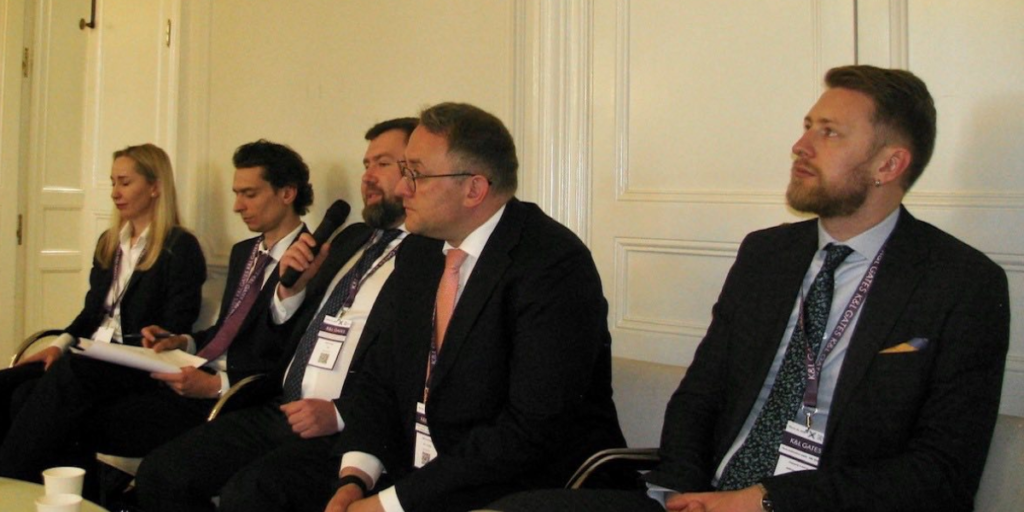
The panel brought together a distinguished group of experts with thorough knowledge of Ukraine’s legal, economic and geopolitical landscape. Anna Babych, partner at AEQUO (Kyiv, Ukraine), chaired the session, guiding a discussion enriched by diverse perspectives. The speakers included Daniel Bilak of Kinstellar (Kyiv, Ukraine), who shared insights on governance, legislative reforms and his unique experience as a practitioner; Roman Dubczak from CIBC Capital Markets (Toronto, Canada), offering a financial and investment viewpoint; Zenon Potoczny of the Ukrainian World Congress (Etobicoke, Canada), emphasising global advocacy and diaspora engagement; and Roman Shimonov, CEO of Roshel Defence Solutions (Brampton, Canada), addressing the role of industry and security in the war (and future reconstruction) efforts.

The discussion centred on broader legal challenges and opportunities arising from Ukraine’s current challenges and future reconstruction efforts. The session’s chair has provided the following review:

‘I had the privilege of moderating the panel dedicated to Ukraine’s rebuild. The discussion brought together leading experts who are actively shaping Ukraine’s recovery. We explored how global business and legal communities can contribute to rebuilding a modern, resilient economy while supporting Ukraine’s long-term stability, with particular focus on Canada’s role and businesses in it.

A key focus of the conversation was the creation of a predictable, secure and investor-friendly environment. Panellists emphasised the importance of clear legal frameworks, risk-mitigation tools and international financial guarantees to attract both institutional and private capital. The discussion highlighted successful examples of early investments and underscored the crucial role of public-private partnerships in driving reconstruction at scale. In particular, the business case of Roshel, Canadian producer and importer of armoured vehicles into Ukraine and its business operations in the Ukrainian environment, demonstrated opportunities of the momentum and development of industrial capabilities in Ukraine at a larger scale.

Special attention was given to the rapidly developing defence and security industry, one of the fastest-growing sectors in Ukraine today. We addressed the unique regulatory, compliance and technological considerations involved, as well as the opportunities for international collaboration and innovation. The panel concluded that Ukraine’s recovery is not only about rebuilding infrastructure but also about strengthening strategic industries. Ultimately, Ukraine’s sustainable reconstruction is inseparable from the success of its defence sector, which ensures security, supports innovation, and creates the conditions necessary for the long-term economic growth of Ukraine and the whole Europe along with that trend.’

— Anna Babych, AEQUO, Kyiv

The session emphasised that Ukraine’s recovery is not only a political and economic challenge but also a legal one. Lawyers and law firms worldwide have a unique opportunity to contribute their expertise in creating a robust framework for justice, governance and sustainable development, while facilitating investment and economic development, which will be essential for rebuilding infrastructure and fostering growth.

As the world’s leading organisation for the legal profession, the IBA and its members are uniquely positioned to support Ukraine’s legal transformation. Through knowledge-sharing, capacity-building and advocacy for the rule of law, the IBA can help ensure that Ukraine’s reconstruction is grounded in strong legal principles. By mobilising expertise across jurisdictions and practice areas, IBA members can play a decisive role in shaping a fair, transparent and resilient legal system – one that not only addresses the immediate challenges of post-war recovery but also lays the foundation for long-term stability and growth.

As a Portuguese lawyer attending this session, I left deeply impressed and moved by the strength of the convictions shared by the panellists and inspired by their message of hope. In the midst of very difficult times, the resilience and determination of the Ukrainian people stand as a powerful reminder of the role that law – and those who practice it – can play in safeguarding justice and enabling recovery. This discussion was not only about legal frameworks and investment strategies; it was about courage, solidarity and the belief that rebuilding Ukraine is a collective responsibility. For me, it reaffirmed that the international legal community has the moral imperative to help Ukraine transform adversity into a foundation for lasting peace and prosperity.

Source: https://www.ibanet.org/rebuilding-ukraine-opportunities-for-lawyers-and-their-clients?

Ministry Clarifies Procedure For Chornomorsk Port Concession Project

The ProZorro system currently lacks the necessary functionality to conduct complex, multi-stage tenders.

The Ukrainian Cabinet of Ministers has updated Resolution No. 909 of 20 August 2021, which establishes the rules for holding tenders to select investors in public-private partnership (PPP) projects. This technical amendment aligns the resolution with the new Law on Public-Private Partnership, which came into force on 31 October 2025. The law stipulates that, from 1 January 2027, all tenders and competitive dialogue procedures must be conducted exclusively through the ProZorro electronic public procurement system.

According to the Ukrainian Ministry for Development of Communities and Territories, the ProZorro and ProZorro.Sales systems currently lack the necessary functionality to conduct tenders under the new law. The ministry expects the development of this technical solution and the launch of an electronic trading system for such tenders to be completed within the next 12 months.

The new law also requires the government and ministries to update all bylaws within a year. There are over 30 such documents, and full implementation of the law is impossible without adapting them.

Currently, international partners, including the EBRD, the IFC, and the World Bank, are involved in the drafting of these acts. They are providing expert and technical support to the Ministry for Development of Communities and Territories and the Ministry of Economy.

The first PPP project being prepared by the ministry concerns the container terminal at Chornomorsk Port. It will be conducted using the competitive dialogue procedure, which is in two stages: prequalification and selection of the best proposal.

Prequalification will ensure that only investors with proven experience in managing large-scale infrastructure facilities and sufficient financial capacity are eligible to take part in the tender. Companies under sanctions, registered in offshore jurisdictions, undergoing bankruptcy proceedings, or linked to the aggressor state will not be eligible.

A tender commission, including representatives from relevant ministries, the local Chornomorsk community, and trade unions, will then determine the best proposal.

The EBRD and the IFC have already engaged leading international advisors to help prepare the tender documentation. According to the ministry, this will ensure a transparent process and compliance with the best global practices.

As previously reported, the Ministry for Development of Communities and Territories held a meeting of the tender commission in November to select an investor for PPP projects involving two terminals at the Chornomorsk port. During the meeting, commission members approved a draft instruction for prospective participants. The document outlines the key requirements, the participation rules, and the application submission procedures.

The final version of the instruction, which will be included in the tender documentation, was also approved. In addition, the commission reviewed and approved amendments to the strategy for implementing and conducting the concession tender under the competitive dialogue procedure.

The updated strategy incorporates proposals from commission members and consultants engaged by international financial institutions, and it clarifies the stages of the project’s further implementation.

Source:https://en.cfts.org.ua/news/ministry_clarifies_procedure_for_chornomorsk_port_concession_project

Ukrainian DefenceTech Startups Raise Over $105 Million in 2025

According to First Deputy Prime Minister and Minister of Digital Transformation Mykhailo Fedorov, Ukraine accounts for one-third of all early-stage DefenceTech investments in Europe.

Ukraine — the European leader in early-stage DefenceTech

Dealroom reports that DefenceTech companies across Europe and the United Kingdom raised a combined $200 million in early-stage funding (Pre-seed, Seed, Series A) in 2025.

Ukrainian startups have become the key beneficiaries of this growth:

  • the number of deals has more than tripled since 2022;
  • the average round size increased from $200,000–400,000 to $2.5–5 million;
  • interest from U.S., U.K., Polish, and Baltic investors has surged due to the proven battlefield effectiveness of Ukrainian technologies.

Highest-funded Ukrainian DefenceTech companies in 2025

According to Fedorov, the largest rounds were raised by:

  • Swarmer — $15 million (autonomous FPV drone swarms);
  • Tencore — $3.74 million (UAV detection and tracking systems);
  • Dropla — $2.75 million (software for UAV command, control, and unit coordination);
  • Teletactica — $1.5 million (next-generation radio systems and situational awareness tech);
  • M-fly — $1.3 million (tactical VTOL drones);
  • Norda Dynamics — $1 million (sensors and control modules for precision weapons).

Additional insights

  • Several Ukrainian DefenceTech solutions are already scaling abroad, including to NATO countries such as the U.S., Poland, and Lithuania.
  • According to Defence iQ, Ukrainian DefenceTech is among the top three fastest-growing DefenceTech ecosystems globally, alongside the U.S. and Israel.
  • The Ministry of Digital Transformation estimates that more than 200 Ukrainian companies operate in drones, robotics, AI, electronic warfare, and tactical systems.

Brave1 — the largest angel-stage DefenceTech investor in Ukraine

Fedorov emphasized that the government-backed Brave1 initiative remains the largest early-stage investor in Ukrainian DefenceTech.
Since its launch, the platform has:

  • funded over 360 projects,
  • awarded more than $7 million in grants,
  • helped dozens of teams obtain certification, achieve production standards, and enter international markets.

The government is also strengthening cooperation with venture funds, including Polish and Estonian investors and several U.S. family offices.

Development of the startup ecosystem

The Ukrainian Startup Fund (USF) was established in 2019. Before the full-scale invasion, it invested $8.2 million in 352 teams, mostly through grants of $25,000–50,000.

After February 2022, the fund shifted entirely to DefenceTech, launching a grant program of up to $35,000 for defence and dual-use solutions in 2023–2024.

In 2024, USF partially resumed support for civilian innovation: the total budget of the renewed program is $2.5 million.

Market insights

According to the Ministry of Digital Transformation, Ukraine has 60 startups per 1 million people, compared with the European average of more than 500.

At the same time, Ukraine shows the fastest growth in Europe in the DefenceTech sector.

Source: https://inventure.com.ua/en/news/world/ukrainian-defencetech-startups-raise-over-dollar105-million-in-2025

Norfund Invests in Dragon Capital’s Rebuild Ukraine Fund to support Ukrainian SMEs

Norway’s Ukraine Investment Fund, managed by Norfund, is investing USD 15 million in the Rebuild Ukraine Fund (REBUF), managed by Dragon Capital, to help address the shortage of equity capital for Ukrainian businesses.

The ongoing war has severely constrained investment activity, leaving small and medium-sized enterprises (SMEs) without the resources needed to grow, create jobs, and contribute to Ukraine’s economy. SMEs are employing over 60% of the workforce in Ukraine.

The Rebuild Ukraine Fund targets a total size of USD 250 million and will focus on majority investments in resilient businesses across sectors such as consumer goods, healthcare, manufacturing, and technology.

“As in Norway, small and medium-sized enterprises form the foundation of Ukraine’s economy. This investment strengthens these businesses, enabling job creation, resilience, and reconstruction during wartime,” says Åsmund Aukrust, Norway’s Minister of International Development.

Norfund’s investment will be part of the fund’s first close, alongside commitments from other European development finance institutions including IFC and EBRD. Together, these contributions will help mobilize additional international capital and strengthen Ukraine’s private sector.

“By providing growth capital to these businesses, we are supporting job creation, innovation, and the rebuilding of critical supply chains. With a dedicated team on the ground and a strategy built for wartime conditions, REBUF will support companies with strong local roots and growth potential,” says Tellef Thorleifsson, CEO of Norfund.

Dragon Capital’s track record and deep local presence make it a great choice for a trusted partner for Norfund in Ukraine.

“The reconstruction of Ukraine depends on companies that continue to operate and invest despite the war. Partnership with Norfund allows Dragon Capital to direct more capital to businesses that are developing new products, expanding capacity, and strengthening local industries. We appreciate the trust of international partners and remain focused on turning it into long-term, practical results for the Ukrainian economy”, says Tomáš Fiala, Founder of Dragon Capital.

This is the second investment made under Norfund’s Ukraine Investment Mandate, which aims to support high-risk, high-impact investments that contribute to the country’s resilience, reconstruction, and long-term integration with European markets.

“Norway’s support for Ukrainian businesses is also an investment in freedom, democracy and economic resilience. By helping sustain economic activity, we strengthen Ukraine’s ability to withstand the aggression and to shape its own future,” says Minister Aukrust.

Topics

Categories


Norfund is the Norwegian Investment Fund for developing countries with a mission to create jobs and improve lives by investing in businesses that drive sustainable development. Owned and funded by the Norwegian Government, Norfund is the Government’s most important tool for strengthening the private sector in developing countries and reducing poverty. Norfund’s committed portfolio amounts to USD 3.8 billion Since December 2024, Norfund has also managed a separate Norwegian Ukraine Investment Fund. For more details, please visit: www.norfund.no

Source: https://www.mynewsdesk.com/norfund/pressreleases/norfund-invests-in-dragon-capitals-rebuild-ukraine-fund-to-support-ukrainian-smes-3420446

Defense startups secure over $105 million in investments since start of year

During 2025, Ukrainian defense tech startups managed to attract more than $105 million from investors.

This was reported on Telegram by First Deputy Prime Minister – Minister of Digital Transformation Mykhailo Fedorov.

According to Fedorov,

“Today the Brave1 defense cluster is the largest angel investor in Ukraine. Thanks to cooperation with it, more than 50 Ukrainian defense tech companies during the current year managed to raise over $105 million from foreign funds, which accounts for a third of all early-stage investments in Europe in the field of defense technologies”

Currently, domestic companies manage to close rounds of $2.5–5 million.

The largest investments were raised by:

  • Swarmer — $15 million
  • Tencore — $3.74 million
  • Teletactica — $1.5 million
  • M-fly — $1.3 million
  • Dropla — $2.75 million
  • Norda Dynamics — $1 million

Source: Ukrainian Defense Tech Startups Raise $105M in 2025 – Oj

Since the beginning of the year, Ukrzaliznytsia has transported over 26.4 million tons of grain

According to operational data, from January to November 2025, Ukrzaliznytsia transported 26.44 million tons of grain, of which 23.3 million tons were for export.

Valeriy Tkachov, Deputy Director of the Commercial Department of Ukrzaliznytsia, reported to Rail.insider:

“Over the first 11 months of this year, a total of 26.445 million tons of grain were transported (28% less than the same period last year). Of this, 23.3047 million tons were sent for export, 26% lower than last year,” the statement said.

In November alone, 2.91 million tons of grain were transported, 16% more than in October, but 1.4% less than in November 2024. In the export direction, 2.57 million tons were shipped, 23% more than in October, but 0.3% less than in November 2024.

Grain shipments to ports accounted for 92% of the total.

Source: Ukraine transports 26.44M tons of grain in 2025 – Oj

USPA presented priority infrastructure projects at the summit in Brussels 

The Ukrainian Sea Ports Authority reports, Ukraine-EU business summit discussed restoration of Ukraine through the prism of European reindustrialization. 

At the panel discussion dedicated to the port industry development, USPA Chairman Oleksandr Semyrga presented a vision for restoration and modernization of Ukrainian port infrastructure both in wartime and in the long-term prospect. 

He focused on development of the Danube ports as strategic multimodal hubs, as well as the need to restore damaged infrastructure of the Greater Odesa ports. 

Oleksandr Semyrga emphasized, “Today, it is important to build-up sustainable partnership and to strengthen cooperation with the international community. Jointly with restoration of infrastructure, we are creating foundation for a modern, competitive and innovative port system of Ukraine”. 

In particular, the USPA confirmed its readiness to implement investment projects in the framework of public-private partnerships, concession mechanisms and with the support of international financial organizations. 

Special attention was drawn to integration of Ukrainian ports into the TEN-T network aimed to strengthen transport sustainability of Europe. 

It should be noted that at the seminar “Investments in Ukrainian Ports: Strengthening the Role as Intermodal Hubs” the delegates presented a list of specific initiatives with high degree of preparation that can be implemented in the short-term prospect. 

Source: https://usm.media/ampu-predstavila-prioritetni-infrastrukturni-pro%D1%94kti-na-samiti-u-bryusseli/